
Why sustainable audit improvement depends on internal controls, accountability and year-round municipal discipline

“Municipal audit outcomes are often treated as an annual event: a result released after the Auditor-General has completed the audit process. In practice, however, an audit outcome is not created at year-end. It is the visible result of what has happened throughout the year: the quality of leadership, the reliability of records, the strength of internal controls, the discipline of monthly reporting, and the willingness of governance structures to insist on accountability.
This matters now because South African municipalities are operating under significant pressure. Communities expect reliable services. Councils must make decisions in a constrained financial environment. Accounting officers must maintain credible records and financial systems. CFOs must ensure that reporting, budgeting, supply chain management and cash-flow practices are sound. Audit committees, Municipal Public Accounts Committees (MPACs) and councils must provide oversight that leads to action, not only discussion.
From my perspective in Bonakude’s KuGompo City office, this issue is especially relevant to municipalities in the Eastern Cape. The province’s local government environment reflects both the progress that is possible and the persistent institutional challenges that must be addressed. Audit improvement must therefore be understood as a year-round leadership and implementation discipline, not a year-end compliance exercise.
The Auditor-General South Africa’s 2024–25 local government reporting confirms that the state of local government remains concerning. Only 39 municipalities, or 15%, achieved clean audits, while 215 municipalities, or 84%, received material findings on compliance with key legislation. The AGSA also reported that 195 municipalities, or 76%, submitted financial statements for auditing that contained material misstatements. These figures reinforce a practical point: audit improvement cannot be left to the audit process itself. It must be built into the daily and monthly operating discipline of each municipality.”
Author: Loyiso Ndebe – Senior Manager / Consulting Division at Bonakude, KuGompo City
Context and Framing: Audit Outcomes are a Leadership Issue
An audit opinion reflects the condition of the institution behind the numbers. It is not simply a technical accounting result; but rather an indicator of how well the municipality is governed, managed and controlled throughout the year.
Where records are complete, reconciliations are performed, policies are updated, assets are properly managed, performance information is supported, and prior-year findings are tracked to closure, the audit process becomes more predictable. Where these disciplines are weak, the audit process often exposes deeper institutional problems: missing evidence, unreliable financial statements, non-compliance, delayed reporting and recurring findings.
This is why audit improvement must be treated as a strategic leadership issue. Finance units play a critical role, but they cannot carry the responsibility alone. Improved outcomes require a functioning accountability ecosystem involving the accounting officer, CFO, senior management, councillors, Municipal Public Accounts Committee (MPAC), internal audit, audit committees, mayors, practitioners and technical support partners.
Sustainable audit improvement therefore depends on deliberate attention to the fundamentals: ethical leadership, skilled finance teams, reliable record management, disciplined Annual Financial Statements (AFS) planning, effective internal controls, timely implementation of audit action plans and visible consequence management. When these areas are managed throughout the year, municipalities are better positioned to reduce repeat findings, improve reporting credibility and strengthen public confidence.
Click the infographic to enlarge.
Why This Matters Now: Audit Weaknesses Are Service Delivery Risks
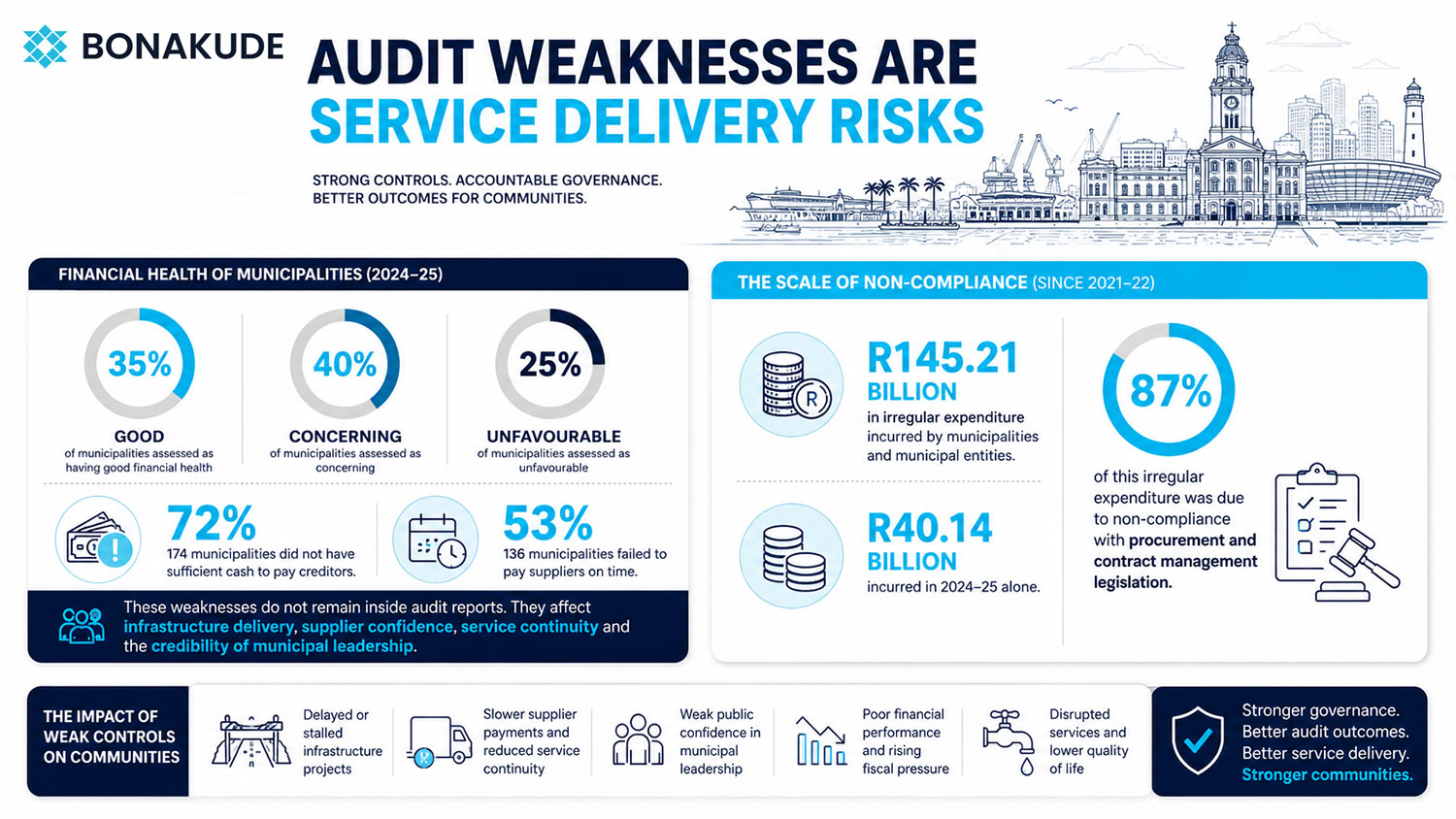
The pressure on municipalities is not limited to audit opinions. It affects financial sustainability, service delivery, infrastructure reliability and public trust.
The AGSA reported that only 35% of municipalities were assessed as having good financial health in 2024–25, while 40% were assessed as concerning and 25% as unfavourable. It also reported that 174 municipalities, or 72%, did not have sufficient cash to pay creditors, while 136 municipalities, or 53%, failed to pay suppliers on time. These weaknesses do not remain inside audit reports. They affect infrastructure delivery, supplier confidence, service continuity and the credibility of municipal leadership.
The scale of non-compliance is equally serious. Since 2021–22, municipalities and municipal entities incurred R145.21 billion in irregular expenditure, with R40.14 billion incurred in 2024–25 alone. According to the AGSA, non-compliance with procurement and contract management legislation was the reason for 87% of this irregular expenditure.
These figures show why municipalities cannot view audit findings as administrative issues or technical notes for the finance department. They are warning signals about governance, financial discipline, service delivery risk and institutional resilience.
This national picture is reflected in different ways across provinces. In the Eastern Cape, the movement in audit outcomes shows that progress is possible, but also that many municipalities remain under pressure to convert corrective actions into sustained institutional improvement. For leaders, practitioners and oversight structures, the challenge is not only to respond to findings, but to build the daily disciplines that prevent them from recurring.
The Eastern Cape Perspective: Turning Audit Movement into Sustained Improvement
As a Senior Manager based in Bonakude’s KuGompo City office, I see the Eastern Cape municipal environment as an important reminder that audit improvement is never only a technical exercise. It is deeply connected to leadership stability, institutional capacity, evidence discipline, governance oversight and the ability of municipalities to turn findings into sustained corrective action.
The province has a complex local government landscape, made up of 39 municipalities: 2 metropolitan municipalities, 6 district municipalities and 31 local municipalities. This diversity matters. A metropolitan municipality, a district municipality and a rural local municipality may face very different operational realities, but the fundamentals of good governance remain consistent: credible records, functioning internal controls, skilled teams, accountable leadership and timeous implementation of audit action plans.
The Eastern Cape audit-outcome movement reflected in the 2023/24 local government reporting shows both progress and continued pressure. Between 2020/21 and 2023/24, clean audits increased from 4 to 6, while disclaimed opinions reduced from 4 to 2. These are encouraging signs. However, qualified opinions increased from 14 to 16, and many municipalities remained in the category of unqualified opinions with findings. This points to a familiar challenge: some institutions are improving, but many are still struggling to sustain the disciplines required for consistently stronger audit outcomes.
For municipalities in the Eastern Cape, this makes the accountability ecosystem particularly important. Audit improvement cannot sit only with the finance unit, and it cannot become visible only during the audit cycle. It must involve accounting officers, CFOs, senior management, practitioners, councillors, Municipal Public Accounts Committees (MPACs), audit committees, internal audit, mayors and support partners working from the same evidence base and towards the same corrective priorities.
From a regional perspective, the lesson is clear: municipalities that want to move from findings to sustainable improvement must build the discipline before year-end. This means resolving record gaps early, reviewing reconciliations monthly, updating policies timeously, preparing Annual Financial Statements (AFS) and Annual Performance Report (APR) support schedules in advance, and ensuring that prior-year findings are tracked with ownership, evidence and consequence management.
The Eastern Cape context also reinforces why capacity building and implementation support must be practical. Municipalities do not only need advice on what should be fixed. They need working systems, clear responsibilities, reliable data, skilled people and management routines that help them follow through. The opportunity is to turn audit movement into institutional improvement that can be sustained beyond a single reporting cycle.
Governance and Legal Foundation: Audit Readiness Is a Year-Round Obligation
The Municipal Finance Management Act (MFMA) makes the municipal manager the accounting officer of a municipality. This role carries direct responsibility for the municipality’s financial administration, including ensuring that resources are used effectively, efficiently and economically, and that full and proper records of the municipality’s financial affairs are maintained.
The MFMA also creates a clear rhythm of in-year financial discipline. Monthly budget statements must be submitted no later than 10 working days after month-end, while annual financial statements must be submitted to the Auditor-General within two months after year-end. These requirements reinforce an important principle: credible year-end reporting depends on disciplined monthly management.
The Public Audit Act confirms the Auditor-General’s mandate to audit and report on the accounts, financial statements and financial management of municipalities and municipal entities. This places audit outcomes within a broader accountability framework, where leadership, records, controls, reporting and consequence management all matter.
Together, these responsibilities show that audit readiness is not a once-off compliance task or an annual response to the audit process, but a continuous governance obligation that must be embedded into how the municipality plans, manages, monitors and accounts for public resources throughout the year.
Recurring Weaknesses Behind Poor Audit Outcomes: Where Discipline Breaks Down
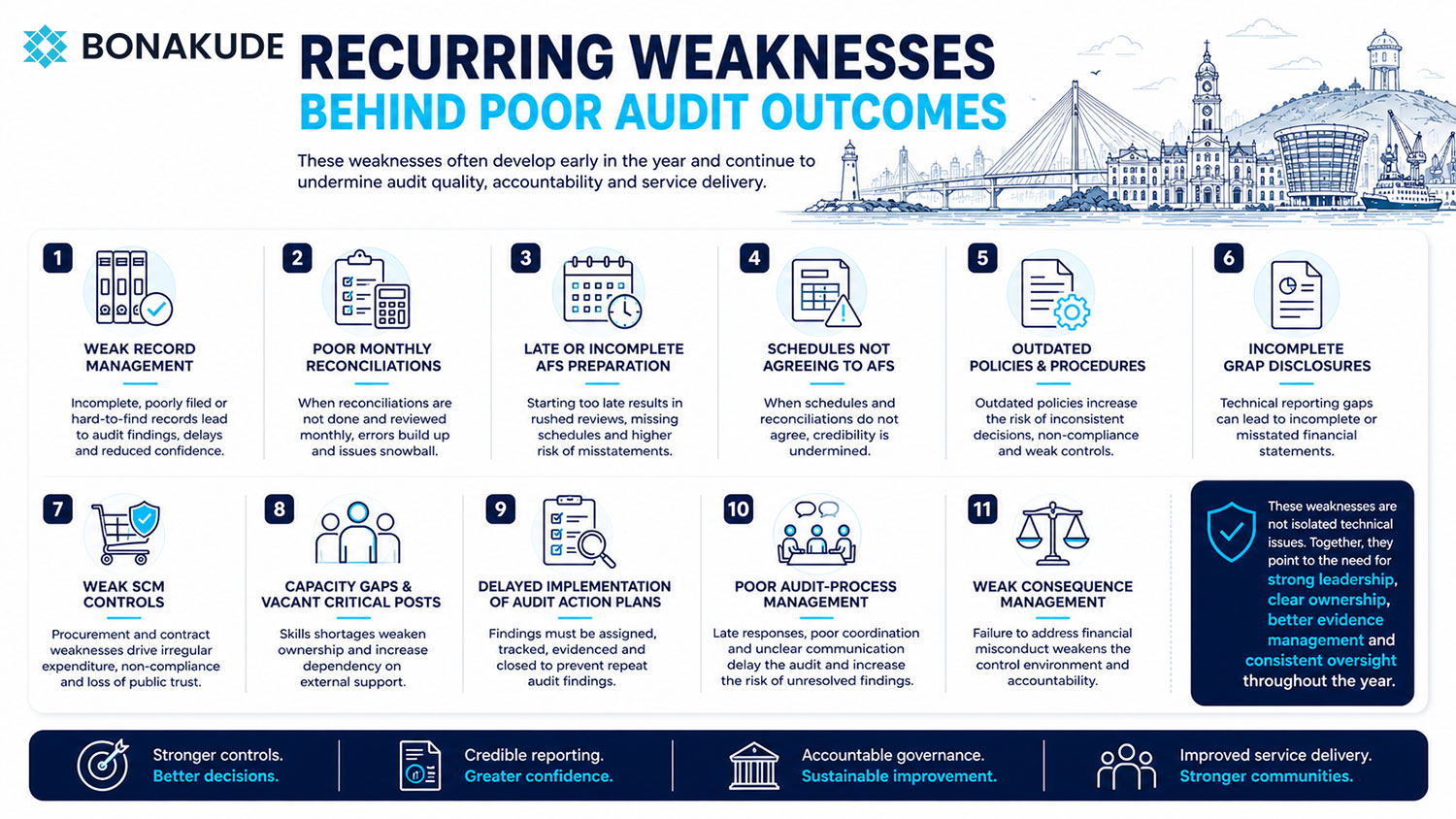
Several recurring weaknesses continue to slow municipal audit improvement. These weaknesses are often visible during the audit process, but their root causes usually develop much earlier in the year.
- Weak record management: When supporting documentation is incomplete, poorly filed or difficult to retrieve, municipalities struggle to support balances, transactions and performance information. This can lead to audit findings, delays, limitations of scope and reduced confidence in reported information.
- Poor monthly reconciliations: Reconciliations should be a routine control, not a year-end clean-up exercise. When they are not performed and reviewed monthly, errors accumulate and finance teams are left trying to resolve months of unresolved issues under audit pressure.
- Late or incomplete AFS preparation: Annual Financial Statements should be the outcome of disciplined monthly financial reporting. When AFS preparation starts too late, quality review is rushed, supporting schedules may be incomplete and material misstatements become more likely.
- Supporting schedules not agreeing to the financial statements: When schedules, registers and reconciliations do not agree to the financial statements, it creates credibility concerns and weakens the municipality’s ability to defend its reported figures.
- Outdated policies and procedures: Policies that are not reviewed timeously increase the risk of inconsistent application, outdated decision-making, non-compliance and weak control execution.
- Incomplete GRAP disclosure notes: Technical reporting gaps, including incomplete or outdated Generally Recognised Accounting Practice (GRAP) disclosures, can result in incomplete or misstated financial statements.
- Weak SCM controls: Procurement and contract management weaknesses often result in irregular expenditure, compliance findings, financial loss and reduced public confidence in how municipal resources are managed.
- Capacity gaps and vacant critical posts: Skills shortages in finance, supply chain management, asset management, performance reporting and internal control functions weaken institutional ownership and can increase reliance on external support.
- Delayed implementation of audit action plans: Prior-year findings must be assigned, tracked, evidenced and closed. When audit action plans are not actively managed, the same weaknesses often return as repeat findings.
- Poor audit-process management: Uncoordinated responses, late information submissions and unclear communication between management, practitioners, auditors and governance structures can delay the audit and increase the risk of unresolved findings.
- Weak consequence management: Where unauthorised, irregular, fruitless and wasteful expenditure is not investigated properly, or where financial misconduct is not addressed, the control environment weakens and accountability becomes less visible.
These weaknesses are not isolated technical issues. Together, they point to the need for strong leadership discipline, clear ownership, better evidence management and more consistent oversight throughout the year.
Click the infographic to enlarge.
A Practical Framework for Sustainable Audit Improvement
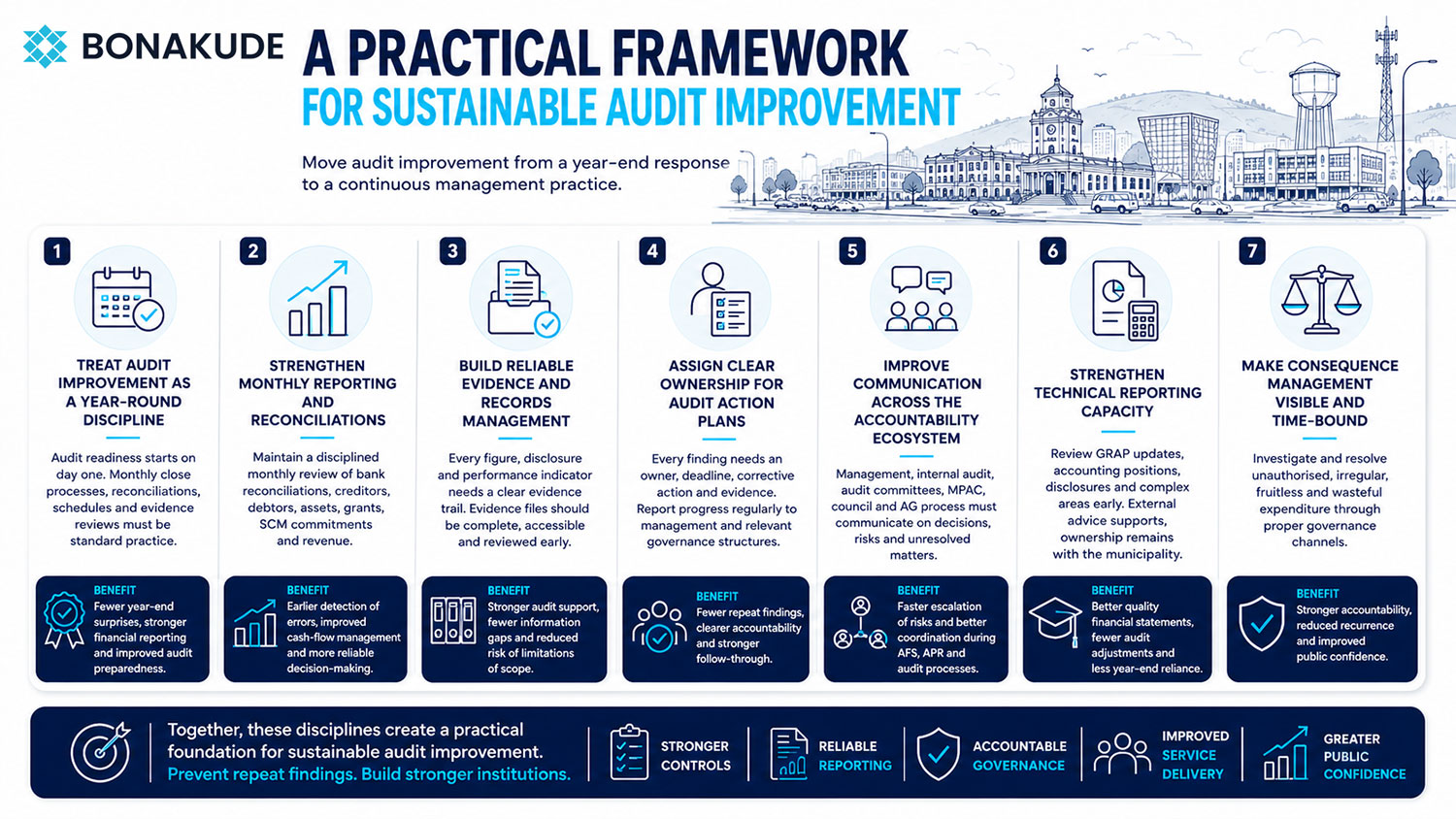
Sustainable audit improvement requires a practical operating framework that municipalities can apply throughout the year. The following disciplines can help move audit improvement from a year-end response to a continuous management practice.
Treat audit improvement as a year-round discipline
Audit readiness should begin on the first day of the financial year, not after year-end. Monthly close processes, reconciliations, supporting schedules and evidence reviews must become standard management practice.
Benefit: Fewer year-end surprises, stronger financial reporting and improved audit preparedness.
Strengthen monthly reporting and reconciliations
Municipalities should maintain a disciplined monthly review process covering bank reconciliations, creditors, debtors, assets, grants, conditional funding, SCM commitments and revenue.
Benefit: Earlier detection of errors, improved cash-flow management and more reliable decision-making.
Build reliable evidence and records management
Every reported figure, disclosure and performance indicator should have a clear evidence trail. Evidence files should be complete, accessible and reviewed before audit requests arrive.
Benefit: Stronger audit support, fewer information gaps and reduced risk of limitations of scope.
Assign clear ownership for audit action plans
Every audit finding should have an accountable owner, a deadline, a corrective action and a defined evidence requirement. Progress should be reported regularly to senior management and relevant governance structures.
Benefit: Fewer repeat findings, clearer accountability and stronger follow-through.
Improve communication across the accountability ecosystem
Management, internal audit, audit committees, MPAC, council and the Auditor-General process should not operate in silos. Communication must be structured, timely and focused on decisions, risks and unresolved matters.
Benefit: Faster escalation of risks and better coordination during the AFS, APR and audit processes.
Strengthen technical reporting capacity
Municipalities should review GRAP updates, accounting positions, disclosure requirements and complex reporting areas early. External advisors can support this process, but ownership must remain with the municipality.
Benefit: Better quality financial statements, fewer audit adjustments and reduced dependence on year-end audit corrections.
Make consequence management visible and time-bound
Unauthorised, irregular, fruitless and wasteful expenditure should be investigated, resolved and reported through the correct governance channels. Consequence management must be fair, evidence-based and time-bound.
Benefit: Stronger accountability, reduced recurrence and improved public confidence.
Together, these disciplines create a practical foundation for sustainable audit improvement. They help municipalities shift from reacting to findings after the fact to managing the controls, records and accountability processes that prevent repeat findings from arising.
Click the infographic to enlarge.
The Accountability Ecosystem: The Role of Each Stakeholder
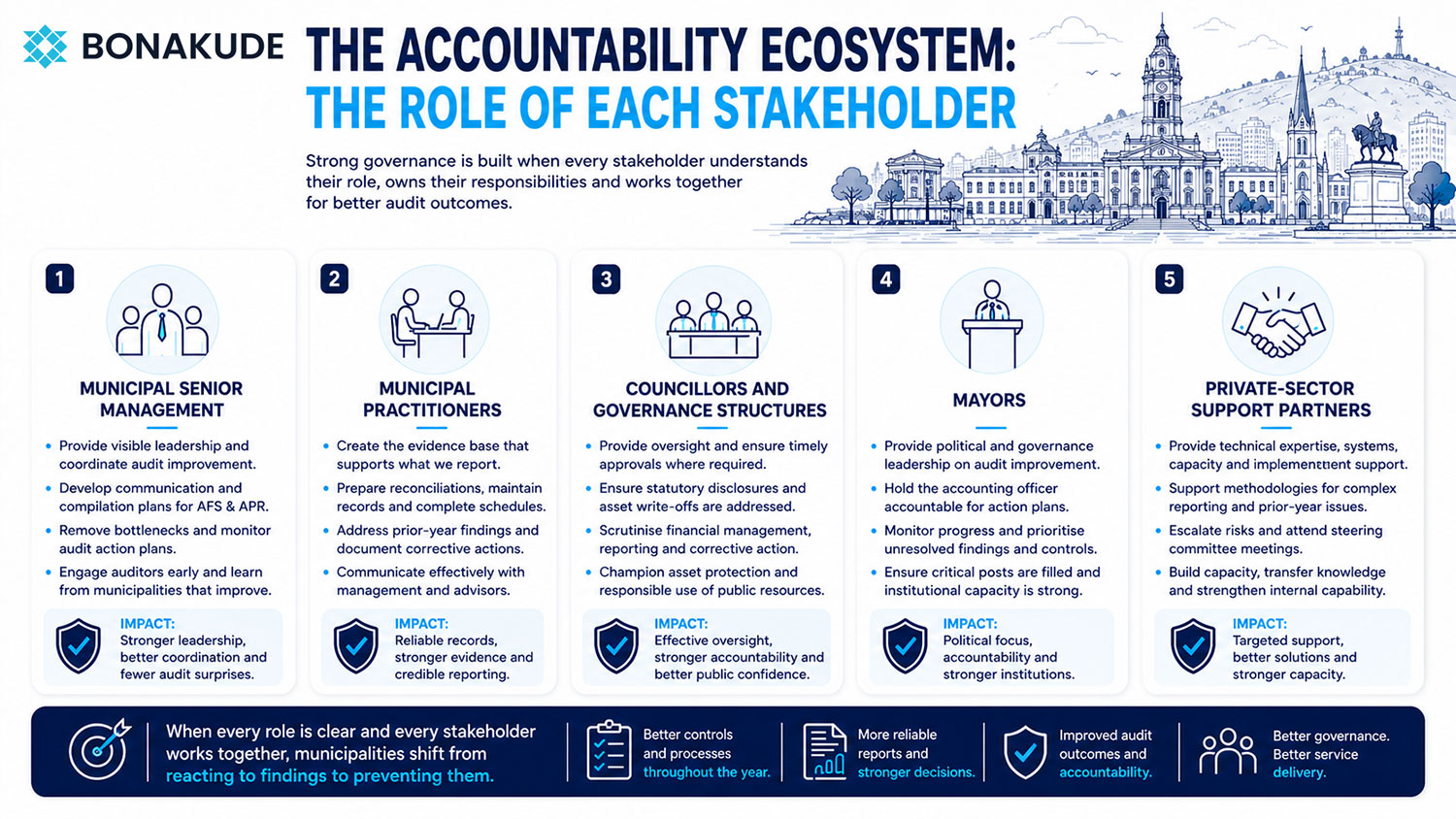
Sustainable audit improvement requires coordinated action across the full municipal accountability ecosystem. No single role-player can resolve recurring audit findings in isolation. Each stakeholder has a distinct responsibility to ensure that planning, evidence, reporting, oversight and corrective action are managed throughout the year.
Municipal Senior Management
Accounting officers, directors and CFOs must provide visible leadership over the audit improvement process. Their responsibility is not limited to reviewing the final Annual Financial Statements or responding to audit findings once they arise. They must actively coordinate the institutional disciplines that support better audit outcomes.
This includes developing clear communication plans with key stakeholders such as managers, the Auditor-General, internal audit and the audit committee. Senior management should also lead the development of AFS and APR compilation plans, appoint capable compilation teams and ensure that accountability for each deliverable is clearly assigned.
A critical part of this role is removing bottlenecks before they delay the compilation or audit process. Senior management must monitor audit action plans, review methodologies used to address complex reporting areas, consult governance committees on approvals and contentious matters, and manage the flow of information between the municipality and auditors.
Where appropriate, senior management should also engage with municipalities that have demonstrated improvement, allowing practical lessons to be adapted and applied. An open-door approach with auditors at senior management level can help resolve issues earlier, reduce misunderstandings and support a more constructive audit process.
Municipal Practitioners
Municipal practitioners, including managers, middle managers and junior officials, are central to the credibility of what the municipality reports. Their work creates the evidence base on which financial statements, performance reports and audit responses depend.
Their responsibilities include compiling working papers to support year-end reports, preparing or reviewing reconciliations, maintaining accurate records and ensuring that supporting schedules are complete, current and aligned to reported information. Where approvals are required, practitioners must ensure that matters are escalated to senior managers timeously.
Practitioners also play an important role in addressing prior-year findings. This means documenting the methodologies used to correct weaknesses, maintaining evidence of implementation and anticipating likely audit queries before they become formal findings.
They are also a critical link between senior management and external support providers. Smooth communication between municipal teams, private-sector advisors and leadership helps ensure that technical work remains aligned to the municipality’s priorities and that all audit information requests are addressed efficiently.
Councillors and Governance Structures
Councillors, MPAC members and council committees provide the oversight environment in which accountability must operate. Their role is to ensure that management receives timely support where council approvals are required, while also maintaining appropriate scrutiny over financial management, reporting and corrective action.
This includes ensuring that statutory disclosures are properly addressed, particularly in relation to unauthorised, irregular, fruitless and wasteful expenditure. Councillors must also ensure that asset write-offs and disposals are properly considered and approved through the correct governance processes.
Their responsibility extends beyond formal meetings. Councillors also have an important public leadership role in helping communities understand the importance of protecting municipal assets in their wards. Asset protection is not only an accounting issue; it directly affects service delivery, infrastructure sustainability and the responsible use of public resources.
Mayors
Mayors have an important leadership and accountability role in the audit improvement environment. While the accounting officer carries administrative responsibility, the mayor must help ensure that there is sufficient political and governance focus on improving institutional performance.
This includes holding the accounting officer accountable for audit action plan implementation, ensuring that progress is monitored and supporting a culture where unresolved findings, vacant critical posts and weak controls are treated as governance priorities.
Mayors also have a role in ensuring that the municipal organisational structure is appropriately filled. Persistent vacancies in finance, SCM, asset management, internal control and performance reporting functions can weaken the municipality’s ability to sustain audit improvement.
Private-Sector Support Partners
Private-sector support partners can add meaningful value where municipalities require technical expertise, additional capacity, systems support or implementation assistance. Their role should begin with understanding the specific needs of the municipality rather than applying generic solutions.
Support may include providing appropriate systems, assisting with methodologies for complex reporting areas, addressing prior-year audit issues, executing approved compilation plans and providing skilled resources aligned to the municipality’s requirements.
Private-sector partners should also report and escalate risks to senior management, attend steering committee meetings where appropriate and provide technical guidance on complex financial reporting, compliance or audit matters.
However, external support should strengthen municipal capability, not replace municipal accountability. The most effective support arrangements are those that transfer knowledge, improve internal discipline and help the municipality build sustainable capacity over time.
Click the infographic to enlarge.
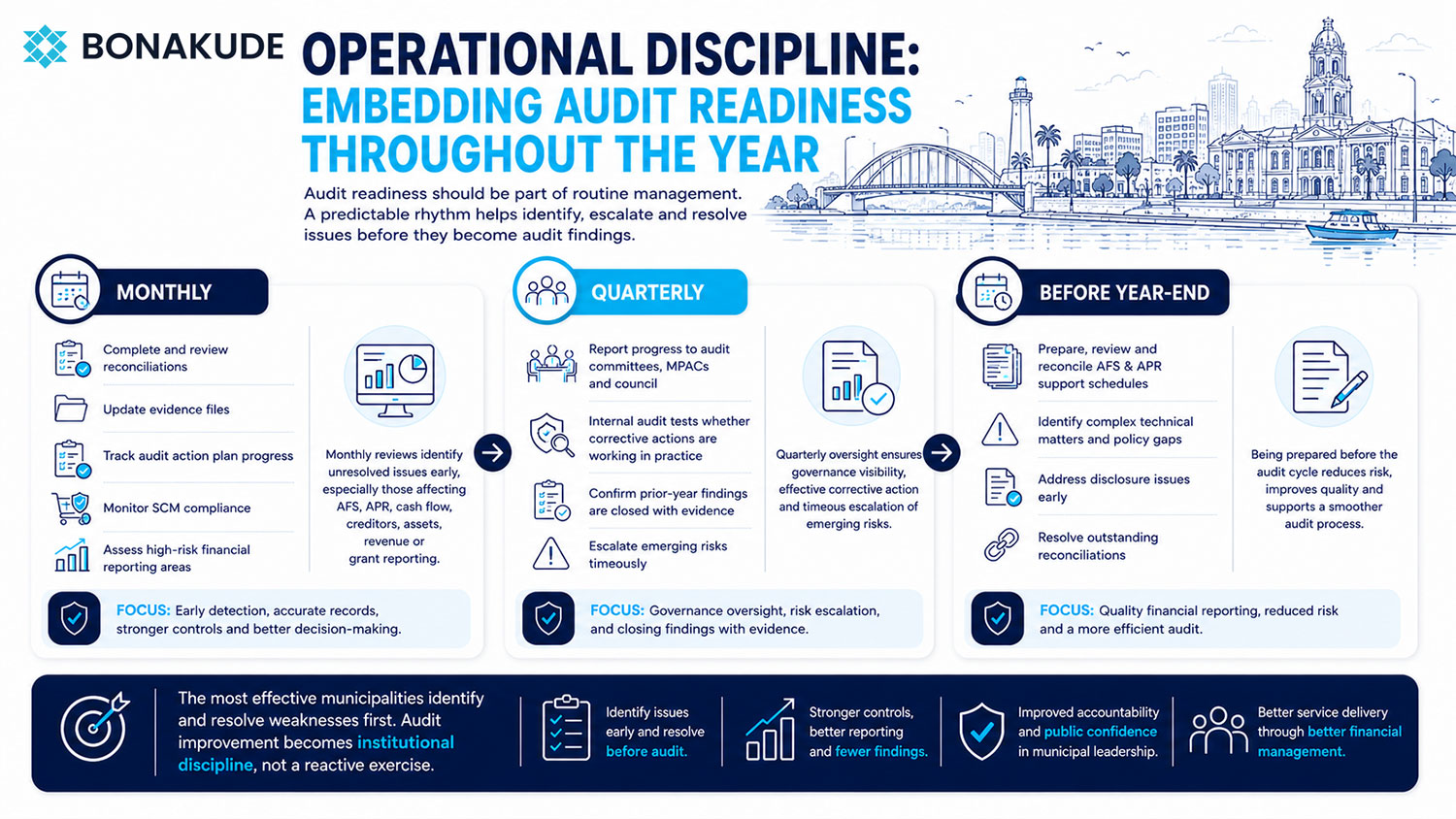
Operational Discipline: Embedding Audit Readiness Throughout the Year
Audit readiness should be embedded into routine management. It requires a predictable operating rhythm that allows weaknesses to be identified, escalated and resolved before they become audit findings.
Monthly
Municipalities should complete and review reconciliations, update evidence files, track audit action plan progress, monitor supply chain management compliance and assess high-risk financial reporting areas. Monthly reviews should also identify unresolved issues early, especially where they may affect Annual Financial Statements (AFS), Annual Performance Report (APR) preparation, cash flow, creditors, assets, revenue or grant reporting.
Quarterly
Senior management should report progress to governance structures, including audit committees, Municipal Public Accounts Committees (MPACs) and council where relevant. Internal audit should test whether corrective actions are working in practice, not only whether they have been documented. Quarterly reviews should also confirm whether prior-year findings are being closed with evidence and whether emerging risks require escalation.
Before year-end
AFS and APR support schedules should be substantially prepared, reviewed and reconciled before the audit cycle begins. Complex technical matters, policy gaps, disclosure issues and unresolved reconciliations should be identified early, not during the audit process.
The most effective municipalities do not wait for the audit to identify weaknesses. They create internal management processes that identify and resolve those weaknesses first. This is where audit improvement becomes part of institutional discipline rather than a reactive compliance exercise.
Click the infographic to enlarge.
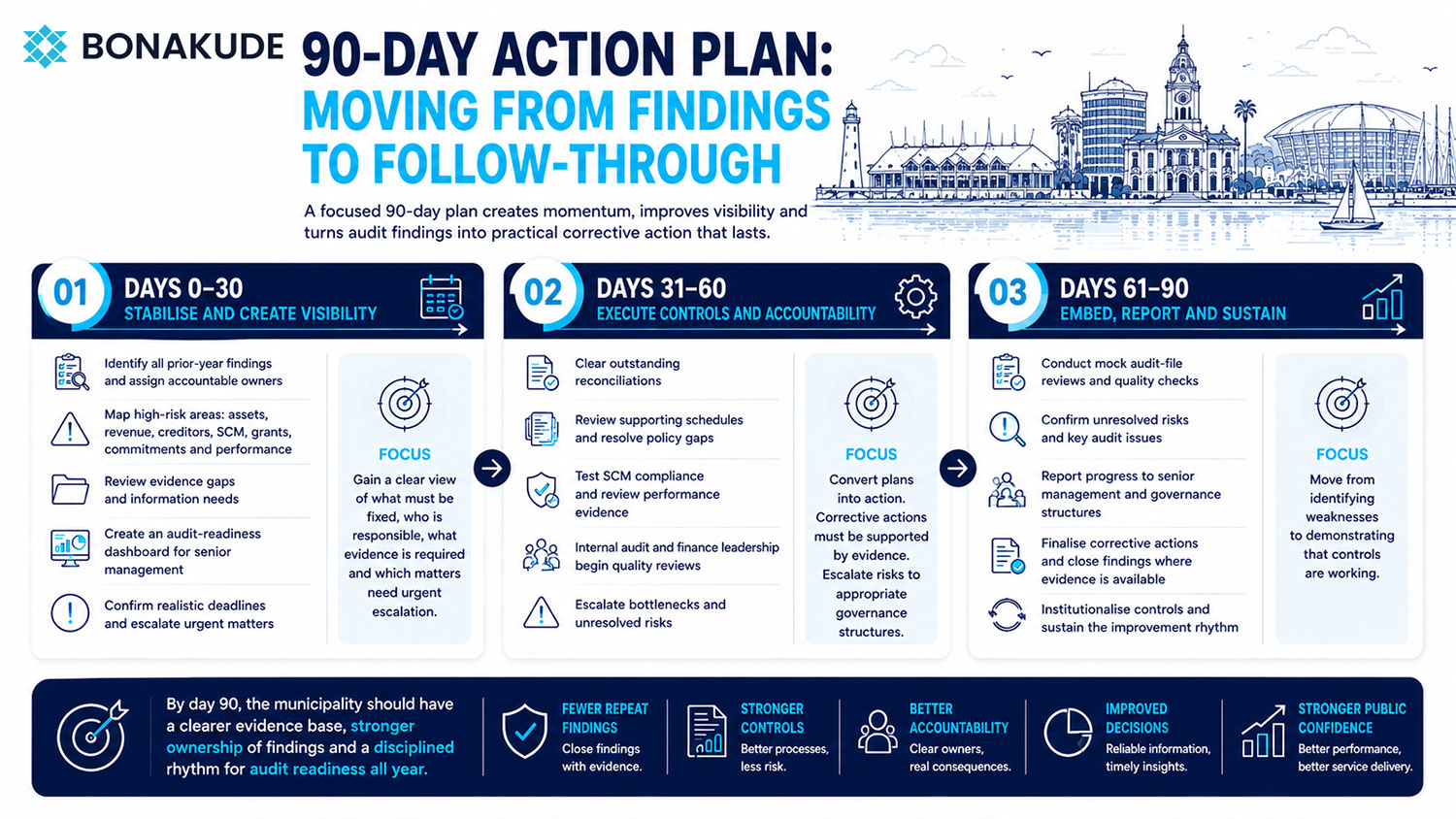
90-Day Action Plan: Moving from Findings to Follow-Through
A 90-day action plan can help municipalities create momentum, improve visibility and move from audit findings to practical corrective action. The aim is not to solve every issue immediately, but to stabilise the environment, assign accountability and prove that controls are beginning to work.
Days 0–30: Stabilise and Create Visibility
Identify all prior-year findings, assign accountable owners and confirm realistic deadlines. Map high-risk areas such as assets, revenue, creditors, supply chain management, grants, commitments and performance information. Review evidence gaps and create an audit-readiness dashboard for senior management.
This phase should give leadership a clear view of what must be fixed, who is responsible, what evidence is required and which matters need urgent escalation.
Days 31–60: Execute Controls and Accountability
Clear outstanding reconciliations, review supporting schedules, resolve policy gaps, escalate bottlenecks, test SCM compliance and review performance evidence. Internal audit and finance leadership should begin quality reviews before audit pressure starts.
This phase should focus on converting plans into action. Corrective actions must be supported by evidence, and unresolved risks should be escalated to the appropriate governance structures.
Days 61–90: Embed, Report and Sustain
Conduct mock audit-file reviews, confirm unresolved risks, report progress to senior management and governance structures, and finalise corrective actions where possible. The municipality should move from identifying weaknesses to demonstrating that controls are working.
By the end of the 90 days, the institution should have a clearer evidence base, stronger ownership of findings and a more disciplined rhythm for monitoring audit readiness throughout the year.
Click the infographic to enlarge.
Why This Matters: Better Governance Builds Public Trust
Better audit outcomes are not the final goal. They are instead an important indicator that the institution is becoming more disciplined, transparent and accountable.
When municipalities maintain reliable records, use resources responsibly, manage infrastructure grants properly, pay suppliers timeously, monitor performance information and act on audit findings, communities benefit. Service delivery planning becomes more credible. Council oversight becomes more meaningful. Financial decisions are better informed. Public trust has a stronger foundation.
A clean audit does not automatically mean that every service delivery challenge has been solved. However, a weak control environment makes sustainable service delivery improvement far more difficult. Where records are unreliable, controls are inconsistent and accountability is delayed, leaders are less able to make sound decisions, protect public resources and respond effectively to community needs.
For the Eastern Cape, and for municipalities across South Africa, the opportunity is not only to improve audit opinions, but rather to strengthen the institutional disciplines that support better decisions, better service delivery, financial resilience and greater public confidence.
Municipalities that build these disciplines throughout the year are better positioned to move beyond compliance and towards lasting institutional performance.
How Bonakude Can Support: From Audit Findings to Practical Implementation
Bonakude supports municipalities, departments and public entities in moving from audit findings to practical, measurable implementation. Our work focuses on helping institutions strengthen the disciplines that sit behind credible reporting, accountable governance and improved service delivery.
This support may include municipal diagnostics, audit action plans, governance reviews, internal control assessments, financial management support, Annual Financial Statements (AFS) and Annual Performance Report (APR) readiness, asset management, revenue management, supply chain management compliance support, risk and compliance, assurance, technical accounting support, training, reporting dashboards and implementation support.
The objective is to help build the systems, routines, skills and accountability mechanisms that make audit readiness part of everyday management. When these disciplines are embedded throughout the year, municipalities are better positioned to reduce repeat findings, improve decision-making and strengthen public confidence.
Author Bio
Loyiso Ndebe has more than 6 years of auditing and consulting experience in the Public and Private Sectors. He is a Senior Manager in the Consulting Division at Bonakude Consulting (Pty) Ltd, where he leads consulting engagements and provides technical expertise in infrastructure asset management, financial reporting, and audit support services.
Throughout his career, he has been involved in numerous auditing and consulting assignments across the Public Sector, servicing municipalities, provincial departments, TVET colleges, universities, and public entities. His experience includes leading infrastructure asset management projects, supporting audit readiness initiatives, preparing and reviewing financial statements, and providing technical accounting advice in accordance with Generally Recognised Accounting Practice (GRAP).
Among his career highlights, Loyiso completed his SAICA articles with the Auditor-General of South Africa (AGSA) and subsequently served as an Audit Senior at both the Auditor-General of South Africa and MMFAS Chartered Accountants and Auditors. He has successfully led asset management projects that have strengthened governance, enhanced GRAP compliance, and contributed to improved audit outcomes for public sector institutions.
His key areas of expertise include: Internal Audit; External Audit; Accounting; AFS & Audit Turnaround; Management Consulting; Fixed Asset Management; and Revenue Management.
We partner with you to make your business work; with foresight, integrity and lasting solutions.
Level 1 B-BBEE | National footprint | Award-winning team
Frequently Asked Questions
When are municipal audit outcomes created?
Municipal audit outcomes are built throughout the year through leadership, reliable records, internal controls, disciplined monthly reporting and accountable governance.
Why is audit improvement a leadership issue?
An audit opinion reflects how well a municipality is governed, managed and controlled, so responsibility extends beyond the finance unit to the full accountability ecosystem.
Which weaknesses commonly cause poor municipal audit outcomes?
Common weaknesses include poor record management, incomplete reconciliations, late AFS preparation, outdated policies, weak SCM controls, capacity gaps and delayed audit action plans.
How can municipalities improve audit readiness throughout the year?
Municipalities can embed monthly reconciliations, evidence reviews, action-plan monitoring, quarterly governance reporting and early preparation of AFS and APR support schedules.
What should a 90-day municipal audit action plan achieve?
It should stabilise the environment, assign accountable owners, address high-risk areas, test controls, escalate unresolved risks and demonstrate evidence of corrective action.
What role do governance structures play in audit improvement?
Councillors, MPACs, audit committees and mayors provide oversight, support necessary approvals, monitor corrective action and hold leadership accountable for implementation.
How can private-sector support strengthen municipal audit outcomes?
Support partners can provide technical expertise, systems, capacity and implementation assistance while transferring knowledge and preserving municipal accountability.
How can Bonakude support municipalities with audit improvement?
Bonakude can support diagnostics, audit action plans, governance reviews, internal controls, AFS and APR readiness, asset and revenue management, assurance, training and implementation.