
What South African Public-Sector Entities Need to Know for 2025/26 Reporting

“Effective for annual reporting periods beginning on or after 1 April 2025, GRAP 104 (Revised) represents one of the most significant updates to public-sector financial reporting in recent years. For many South African public-sector entities, the 2025/26 financial statements will be the first prepared under the revised standard.
Issued by the Accounting Standards Board (ASB), GRAP 104 (Revised) modernises financial-instruments accounting through principles broadly aligned with international best practice, including concepts found in IFRS 9, while remaining appropriate for the public-sector environment.
The revised standard introduces a more robust framework for classification and measurement, a forward-looking approach to impairment, updated requirements for certain instruments and more detailed credit-risk and other disclosures. Together, these changes support more consistent and transparent public-sector reporting.”
Author: Isaac Magwanyana CA(SA) – Senior Manager / External Audit Division at Bonakude
The Business Case for GRAP 104 (Revised)
The original GRAP 104 has served as the cornerstone of public sector accounting for financial instruments for many years. However, since its introduction, public sector entities have entered into increasingly sophisticated financial arrangements, making financial reporting significantly more complex.
Today, many public sector entities routinely account for arrangements such as:
- Concessionary loans
- Receivables with complex repayment terms
- Financial guarantees
- A broader range of investment instruments
These developments exposed limitations in the original standard, particularly around classification, impairment and the accounting treatment of concessionary lending.
GRAP 104 (Revised) addresses these challenges by providing clearer principles that reflect the economic substance of financial instruments while remaining tailored to the unique environment of government and public sector reporting.
Among the most significant changes are:
- A revised classification model based on business models and contractual cash flow characteristics
- A forward-looking Expected Credit Loss (ECL) impairment model replacing the incurred loss approach
- Updated measurement and presentation requirements, including for certain concessionary instruments
- More detailed credit-risk, transition and other disclosures
Rather than being a simple technical update, GRAP 104 (Revised) changes how many public sector entities identify, measure, assess and disclose financial instruments throughout the reporting cycle.
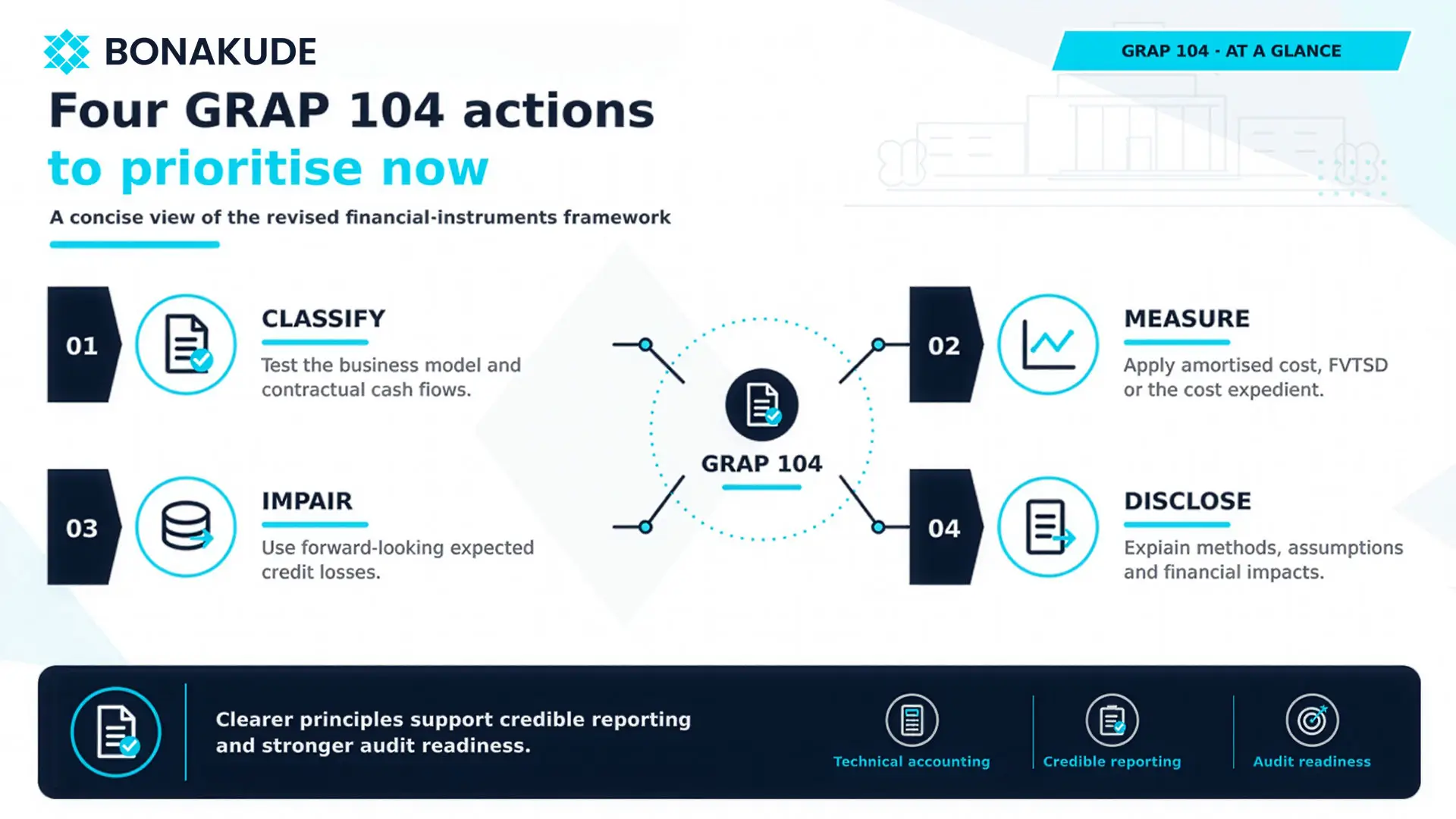
Click the infographic to enlarge.
Which Entities Must Apply GRAP 104 (Revised)?
The revised standard applies to all entities preparing financial statements in accordance with Standards of Generally Recognised Accounting Practice (GRAP), including:
- Municipalities and municipal entities
- National and provincial public entities
- Constitutional institutions
- Technical and Vocational Education and Training (TVET) colleges
- Community Education and Training (CET) colleges
- Public higher education institutions
Any entity with financial assets, financial liabilities or equity instruments is likely to be affected.
As a result, the revised standard is particularly important for professionals involved in:
- Public sector accounting
- Public finance management
- Accounting policy development
- Audit and assurance within the public sector
Key Developments Introduced by GRAP 104 (Revised)
A More Principle-Based Classification Model
One of the most important changes is the revised approach to classifying financial assets.
Instead of relying primarily on predefined accounting categories, the revised classification model focuses on two key questions:
- How does the entity manage the financial asset (its business model)?
- What are the contractual cash flow characteristics of the instrument?
This approach more closely reflects how financial assets are managed in practice and ensures that accounting treatment aligns with the economic purpose of each instrument.
Depending on the outcome of these assessments, financial assets may be measured at:
- Amortised cost
- Fair value through surplus or deficit (FVTSD)
- Cost for residual interests when reliable fair value is unavailable (a practical expedient)
Finance teams should not assume existing classifications remain appropriate simply because balances have not changed. The underlying rationale supporting those classifications must also be reassessed and documented.
A Forward-Looking Approach to Impairment
Perhaps the most significant practical change is the introduction of the Expected Credit Loss (ECL) model.
Under the previous standard, impairment losses were recognised only after objective evidence indicated that a loss event had occurred. GRAP 104 (Revised) requires entities to recognise expected credit losses using reasonable and supportable information about past events, current conditions and forecasts of future economic conditions.
This change has significant implications for entities with:
- Consumer debtor books
- Intergovernmental receivables
- Long-outstanding balances
- Significant credit risk exposures
Finance teams will therefore need robust methodologies to estimate expected credit losses and maintain appropriate documentation supporting assumptions, historical trends and forward-looking information.
Stronger impairment methodologies will not only improve compliance with GRAP but also strengthen audit readiness and financial reporting quality.
Concessionary Loans and Credit Impairment
Concessionary loans are common within the public sector and frequently include below-market interest rates, extended repayment periods or grace periods.
GRAP 104 retains the need to separate the financing and concessionary components, while the revised impairment model affects how credit risk is assessed.
Entities must assess the difference between:
- The fair value of the loan at initial recognition
- The transaction price
That difference may need to be recognised separately depending on the nature of the transaction and the applicable GRAP requirements. Depending on the circumstances, it may be recognised as revenue, an expense or as part of the cost of another asset.
This approach ensures that the economic substance of the concession provided is reflected separately from the financing transaction itself.
In practice, this area may prove challenging, particularly where historical loan agreements were drafted before current accounting requirements existed.
Derecognition Remains Important
The derecognition principles are not a headline change in GRAP 104 (Revised), but they remain important when financial assets or liabilities are transferred, modified or settled.
Entities should continue to apply the standard carefully when deciding whether an instrument should be removed from the statement of financial position.
This guidance is particularly relevant for entities dealing with:
- Transfer payment arrangements
- Debt restructuring
- Intergovernmental balances
- Settlements and modifications
Consistent application of these principles supports more reliable public sector financial reporting and reduces uncertainty during the audit process.
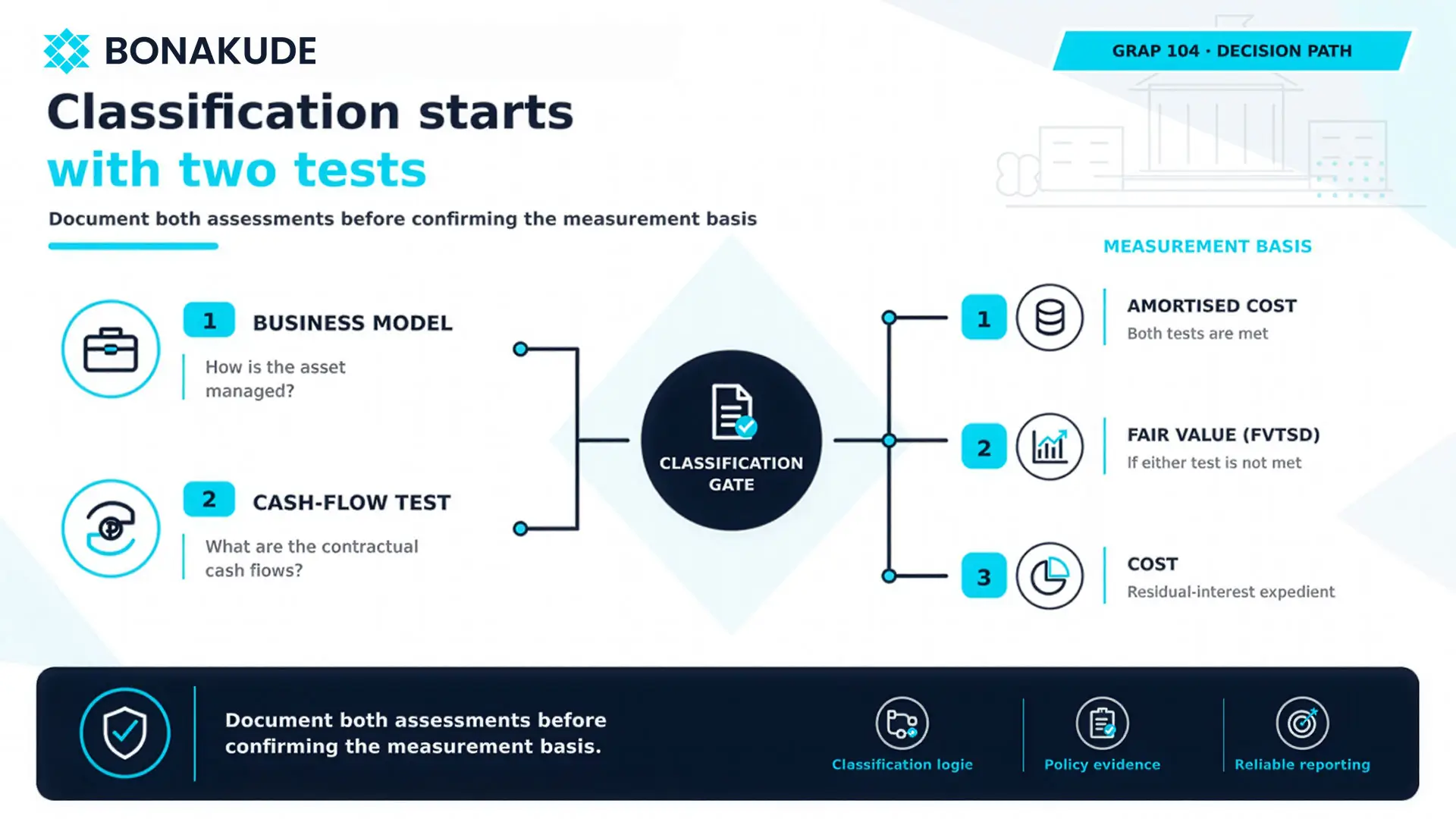
Click the infographic to enlarge.
What GRAP 104 (Revised) Means for Financial Statement Disclosures
The most significant disclosure changes relate to credit risk, expected credit losses, certain designated instruments, reclassifications and transition. Existing liquidity-risk and fair-value disclosure requirements continue to apply.
Entities will generally need to disclose information covering several key areas:
Classification and Measurement
Financial statements should clearly explain:
- The classification applied to each category of financial instrument
- The measurement basis used
- Significant accounting policies supporting these classifications
Credit Risk and Expected Credit Losses
Entities will also need to provide:
- Reconciliations of movements in expected credit loss allowances
- Information about credit risk exposures
- Concentrations of credit risk
- Key assumptions supporting expected credit loss calculations
Liquidity Risk
Existing requirements continue to include:
- Maturity analyses of financial liabilities
- Information explaining how liquidity risk is managed
Fair Value Information
Existing fair-value disclosures continue to address:
- Fair value measurement techniques
- Significant valuation inputs
- Fair value hierarchy levels
Concessionary Loans
Additional disclosures may also be required regarding:
- The terms of concessionary loans
- The accounting treatment applied
- Significant judgements made by management
For many entities, the expanded credit-risk and transition disclosures will be a significant implementation challenge. Robust internal review and consistent cross-referencing throughout the annual financial statements will be essential.
Common Risk Areas During Implementation
Entities implementing the revised standard should pay particular attention to the following areas:
Misclassification of Financial Assets
Entities may continue using historical classifications without reassessing business models and the contractual cash flow characteristics of the financial asset as required by the revised standard.
Weak Expected Credit Loss Methodologies
Expected credit loss calculations based solely on historical provision percentages, without incorporating reasonable forward-looking information, are unlikely to satisfy audit requirements.
Incorrect Accounting for Concessionary Loans
Below-market loans may not be identified appropriately, resulting in the concessionary element being omitted or incorrectly measured.
Incomplete Fair Value Disclosures
Disclosures that omit valuation methodologies, significant assumptions or fair-value hierarchy levels may not meet the applicable disclosure requirements.
Inconsistencies Across Financial Statement Notes
Financial instruments disclosures should reconcile with other notes throughout the annual financial statements to ensure consistency and completeness.
Addressing these areas proactively will improve reporting quality and reduce implementation risk.
Preparing for Successful Implementation
Begin with a Gap Assessment
An effective implementation starts with understanding where current accounting practices differ from the revised standard.
Review:
- Existing financial instrument classifications
- Current impairment methodologies
- Concessionary loan arrangements
- Accounting policies
- Financial statement disclosures
- Supporting working papers
A structured gap assessment enables finance teams to identify required changes before year-end reporting pressures arise.
Update Accounting Policies and Procedures
Most entities will also need to revise their accounting policies and procedures.
Updated policies should clearly explain:
- Classification principles
- Measurement bases
- Expected credit loss methodologies
- Accounting for concessionary loans
- Financial statement disclosure processes
Entities should not assume existing accounting policies remain appropriate simply because accounting outcomes appear unchanged. Supporting policies, documentation and decision-making frameworks may also require revision.
Where additional implementation support is required, structured financial consulting can help entities work through accounting, documentation and reporting requirements.
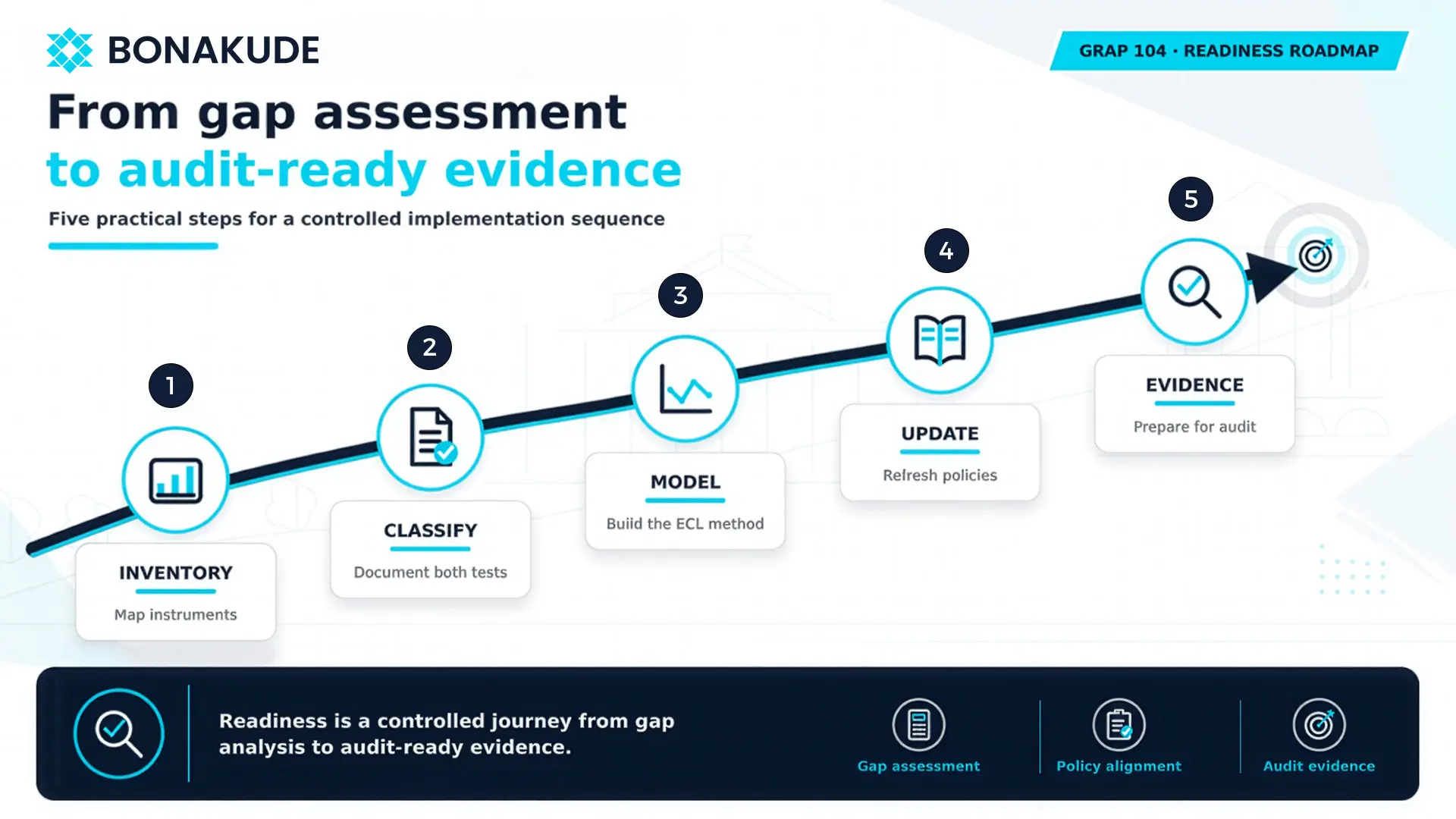
Click the infographic to enlarge.
Looking Ahead
GRAP 104 (Revised) is more than a technical accounting update. It represents a significant step towards more transparent, consistent and forward-looking financial reporting within the South African public sector.
Although implementation will require careful planning, robust documentation and enhanced professional judgement, it also presents an opportunity for finance teams to strengthen governance, improve financial reporting quality and enhance confidence in published financial statements.
Entities that prepare early by reassessing financial instrument classifications, strengthening impairment methodologies, updating accounting policies and reviewing disclosure processes will be better positioned for a smoother transition and stronger audit outcomes.
Author Bio
Isaac Magwanyana CA(SA) has more than 9 years of auditing experience in the Public and Private Sectors. He is a Senior Manager in the External Audit Division at Bonakude, where he leads external audit engagements and provides technical expertise in governance, financial reporting, and assurance services.
Throughout his career, he has been involved in numerous auditing assignments across the Public Sector, servicing municipalities, provincial departments, TVET colleges, universities, public entities and private sector clients. His experience includes leading audit teams, preparing and reviewing financial statements, and providing technical accounting advice in accordance with Generally Recognised Accounting Practice (GRAP).
Among his career highlights, Isaac completed his SAICA articles with the Auditor-General of South Africa (AGSA) and subsequently served as an Assistant Manager at BDO UK, and Manager at Grant Thornton UK and Deloitte Africa. He has successfully led assurance engagements projects that have strengthened governance, enhanced GRAP compliance, and contributed to improved audit outcomes for public sector institutions.
His key areas of expertise include Internal Audit; External Audit; Accounting; AFS Review and Forensic investigations.
We partner with you to make your business work; with foresight, integrity and lasting solutions.
Level 1 B-BBEE | National footprint | Award-winning team
How can Bonakude support your GRAP 104 implementation readiness?Frequently Asked Questions
What are the main changes in GRAP 104 (Revised)?
The main changes include revised classification and measurement principles, a forward-looking expected-credit-loss model, updated requirements for certain instruments, and more detailed credit-risk, transition and other disclosures.
Which public-sector entities are affected by GRAP 104 (Revised)?
The revised standard affects entities applying Standards of GRAP that hold financial assets, financial liabilities or equity instruments, subject to the scope requirements in the standard.
How should finance teams prepare for implementation?
Begin with a gap assessment, reassess classifications, strengthen expected-credit-loss methods, update accounting policies and retain clear evidence for review and audit.
How are financial assets classified under GRAP 104 (Revised)?
Classification considers how the entity manages the financial asset and the instrument’s contractual cash flow characteristics. Depending on the assessment, measurement may be at amortised cost, fair value through surplus or deficit, or cost for qualifying residual interests.
What is the Expected Credit Loss model under GRAP 104 (Revised)?
The Expected Credit Loss model requires entities to recognise expected credit losses using reasonable and supportable information about past events, current conditions and forecasts of future economic conditions.
How does GRAP 104 (Revised) affect concessionary loans?
Entities must distinguish the financing and concessionary components and assess the difference between the loan’s fair value at initial recognition and its transaction price, while also applying the revised impairment requirements.
What disclosure areas require particular attention under GRAP 104 (Revised)?
Key areas include classification and measurement, credit risk and expected credit losses, liquidity risk, fair value information, concessionary loans, reclassifications and transition disclosures.
How can Bonakude support GRAP 104 implementation readiness?
Bonakude can support public-sector entities with gap assessments, accounting and financial reporting, policy and methodology reviews, audit readiness and assurance-related requirements.