
Why Audit Turnaround Is Critical to Operational Efficiency in South Africa’s Public Sector

“Across South Africa’s public sector, audit outcomes under the Public Finance Management Act (PFMA) and Municipal Finance Management Act (MFMA) continue to tell a familiar and uncomfortable story: persistent control failures, limited clean audits, and repeated regressions despite years of reform efforts.
The most recent consolidated audit outcomes underscore this stagnation. According to the Auditor-General’s reporting, auditees managing the vast majority of public resources still lack the institutional capability to produce credible financial and performance reports. Even more concerning is that regressions continue to occur in environments where there have been no meaningful changes in legislation or reporting requirements - suggesting that the issue is not complexity, but execution.”
Author: Prosper Mutambirwa AGA (SA) - Senior Manager: Consulting at Bonakude
When Compliance Becomes a Symptom, Not the Problem
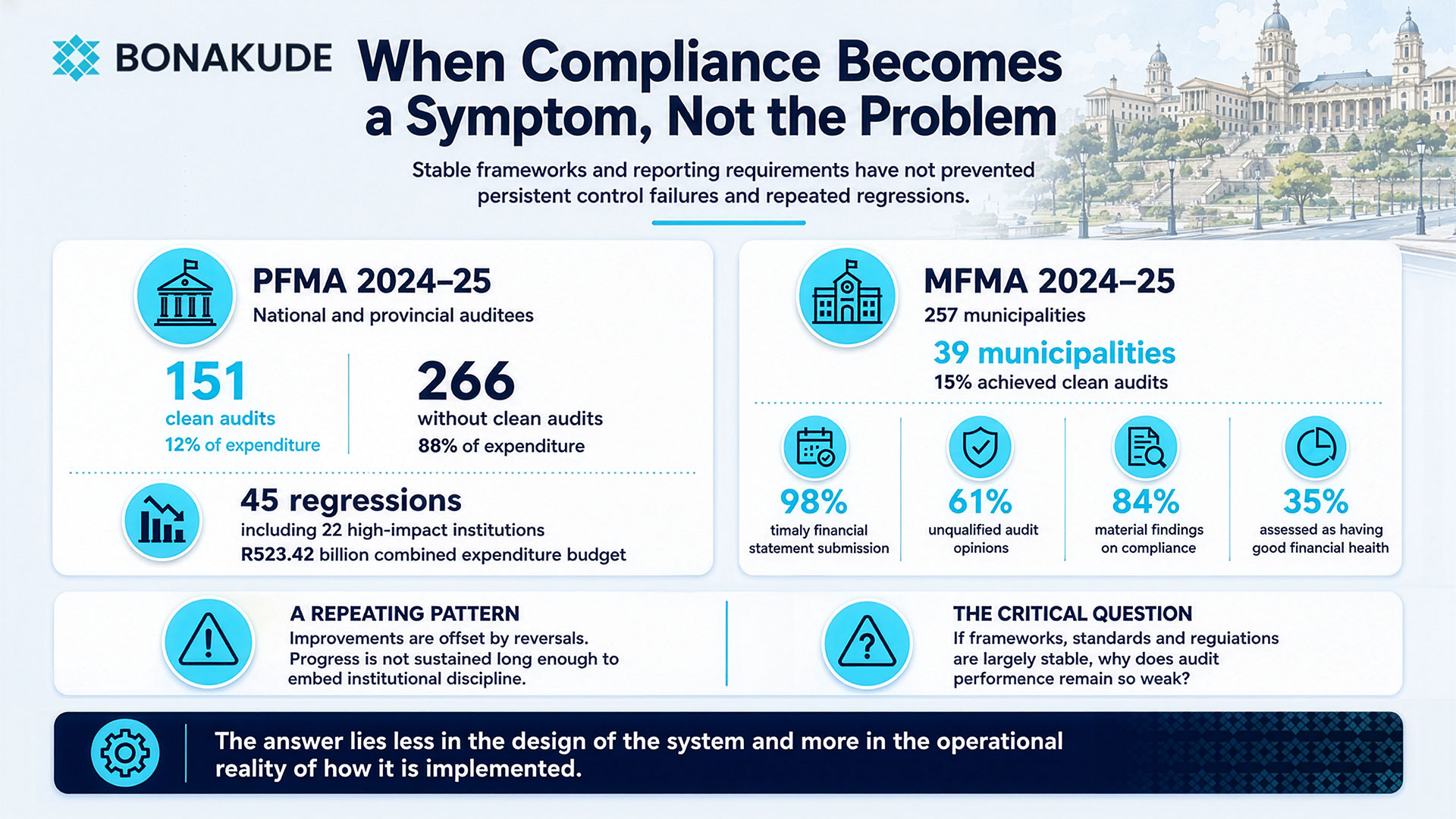
The 2024-25 PFMA outcomes sharpen the scale of the problem. While 151 national and provincial auditees achieved clean audits, they accounted for only 12% of the expenditure budget. The 266 auditees that did not receive clean audits managed 88% of expenditure. Regressions were recorded at 45 auditees, including 22 high-impact institutions, representing a combined expenditure budget of R523.42 billion.
At local government level, the MFMA outcomes mirror this trend. Improvements are consistently offset by reversals, reinforcing a pattern where progress is not sustained long enough to embed institutional discipline.
The latest MFMA results show the same tension between incremental progress and persistent institutional weakness. In 2024-25, 39 of 257 municipalities (15%) achieved clean audits. Timely submission of financial statements improved to 98% and 61% of municipalities received unqualified audit opinions, yet 84% still had material findings on compliance and only 35% were assessed as having good financial health.
This raises a critical question: if frameworks, standards, and regulations are largely stable, why do audit outcomes remain weak?
The answer lies less in the design of the system and more in the operational reality of how it is implemented.
Click the infographic to enlarge.
The Real Constraints Behind Weak Audit Outcomes
The recurring findings from the Auditor-General point to a system under pressure at the most fundamental level of administration. The issues are not abstract - they are operational and structural.
Finance units across departments and municipalities often lack the necessary technical skills to manage increasingly complex reporting requirements. This is compounded by poor records management, which undermines the ability to produce reliable financial statements or substantiate transactions during audits.
A further challenge is the lack of disciplined planning around annual financial statement (AFS) preparation. In many cases, AFS preparation is treated as a year-end compliance exercise rather than a continuous process embedded into daily financial management. This reactive approach creates predictable bottlenecks during audit cycles.
Internal controls remain another weak link. Policies may exist on paper, but their enforcement is inconsistent. Where controls do exist, they are often outdated, poorly communicated, or not aligned with operational realities.
Staffing constraints further exacerbate the problem. Vacant positions in critical finance and supply chain roles are not filled timeously, leading to reliance on overextended teams or underqualified personnel. In such environments, even well-designed systems fail under operational strain.
The scale of the capacity gap is also visible in the use of external support. In 2024-25, 225 municipalities spent R1.61 billion on financial reporting consultants. Yet 61% of municipalities that used consultants still submitted financial statements with material misstatements in the areas for which consultants were appointed. The Auditor-General attributed the appointments to a lack of skills (53%), a combination of skills shortages and vacancies (41%), or vacancies alone (6%). Outsourcing can provide short-term support, but these figures reinforce the need for deliberate skills transfer and sustainable internal capability.
Finally, there is the persistent issue of weak consequence management. Audit action plans are often developed, but delayed or inconsistently implemented. Without enforcement, corrective action becomes procedural rather than transformative.
These weaknesses collectively manifest in recurring qualification areas such as property, plant and equipment, revenue and receivables, payables, expenditure, and grant management. These are not isolated technical issues - they are indicators of systemic control breakdown.
Why Traditional Compliance Approaches Are Not Enough
For many institutions, the default response to poor audit outcomes has been more compliance: more checklists, more reporting, and more policies. Yet the persistence of audit regressions suggests that compliance alone is not producing operational improvement.
This is visible in the national and provincial results. The most common 2024-25 PFMA outcome was 'unqualified with findings', affecting 161 auditees. Seventy per cent of this group had the same outcome in both 2023-24 and 2024-25, 35% had remained in the category for at least five years, and more than half achieved an unqualified opinion only after correcting material misstatements identified during the audit. An unqualified opinion can therefore mask persistent operational weaknesses when it is treated as an endpoint rather than a platform for improvement.
The underlying issue is that internal control environments are not functioning as integrated systems. They are fragmented, inconsistently applied, and often disconnected from day-to-day operational decision-making.
A strong control environment is not defined by documentation, but by behaviour and accountability. Ethical leadership, clear organisational structures, segregation of duties, and consistent enforcement of policies are not optional governance ideals - they are operational requirements.
Without these foundations, audit readiness becomes an annual scramble rather than a sustained capability.
Reframing Audit Turnaround as Operational Efficiency
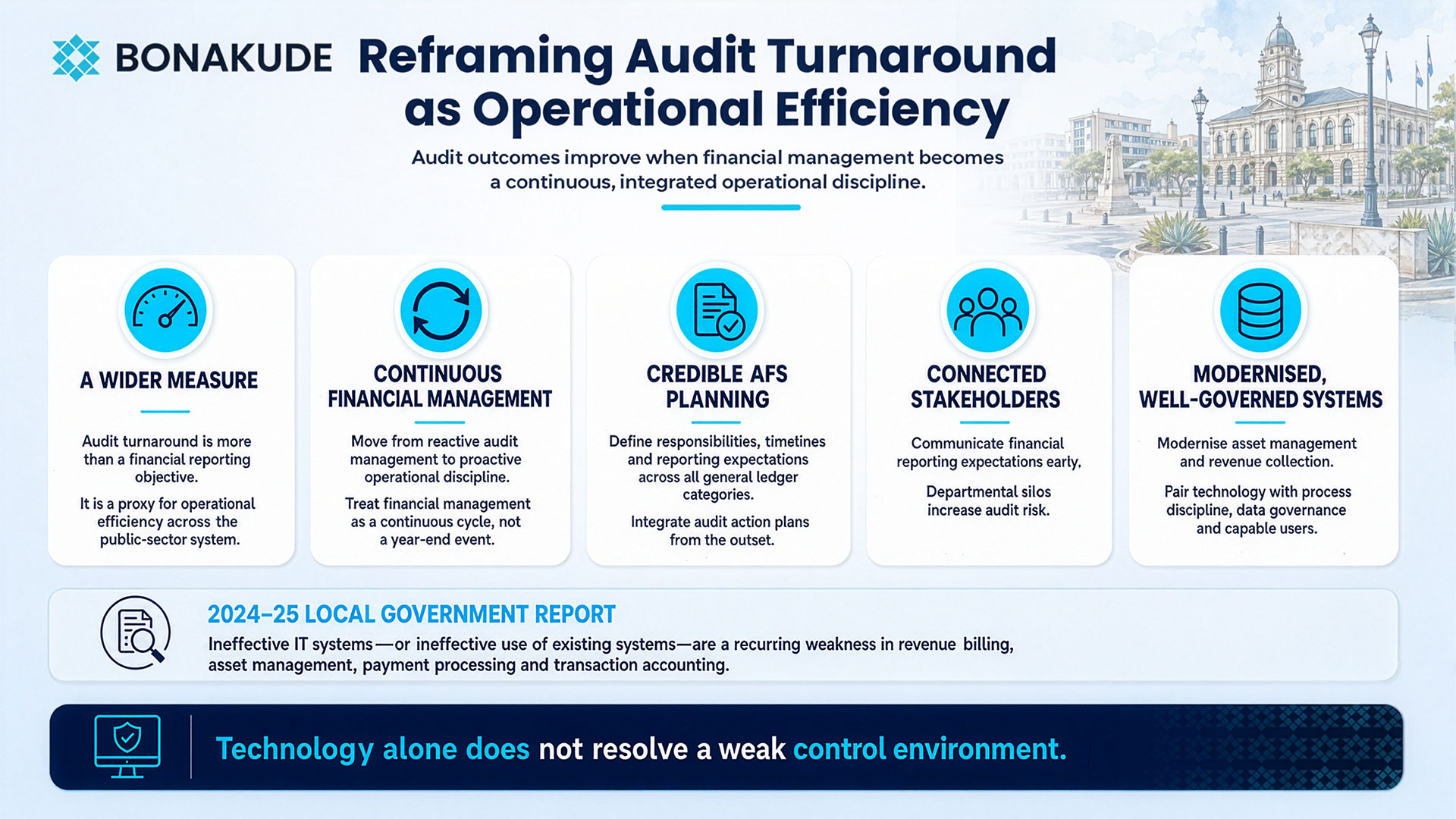
Audit turnaround is often viewed narrowly as a financial reporting objective. In reality, it is a proxy for operational efficiency across the entire public sector system.
Improving audit outcomes requires shifting from reactive audit management to proactive operational discipline. This begins with treating financial management as a continuous cycle rather than a year-end event.
A credible annual financial statements (AFS) process, for example, should be supported by a detailed compilation plan that identifies responsibilities, timelines, and reporting expectations across all general ledger categories. Crucially, this must be integrated with audit action plans from the outset, not developed after issues emerge.
Equally important is timely communication of financial reporting expectations to all stakeholders. Where departments operate in silos, audit risk increases exponentially.
Modernising financial systems - particularly in areas such as asset management and revenue collection - also plays a critical role. Manual or fragmented systems are no longer sufficient for the level of reporting complexity required in the public sector.
The 2024-25 local government report specifically identifies ineffective IT systems - or the ineffective use of existing systems - as a recurring weakness in processes such as revenue billing, asset management, payment processing and transaction accounting. Digital modernisation must therefore be accompanied by process discipline, data governance and capable users; technology alone does not resolve a weak control environment.
Click the infographic to enlarge.
Strengthening the Foundations: Records, Controls, and Skills
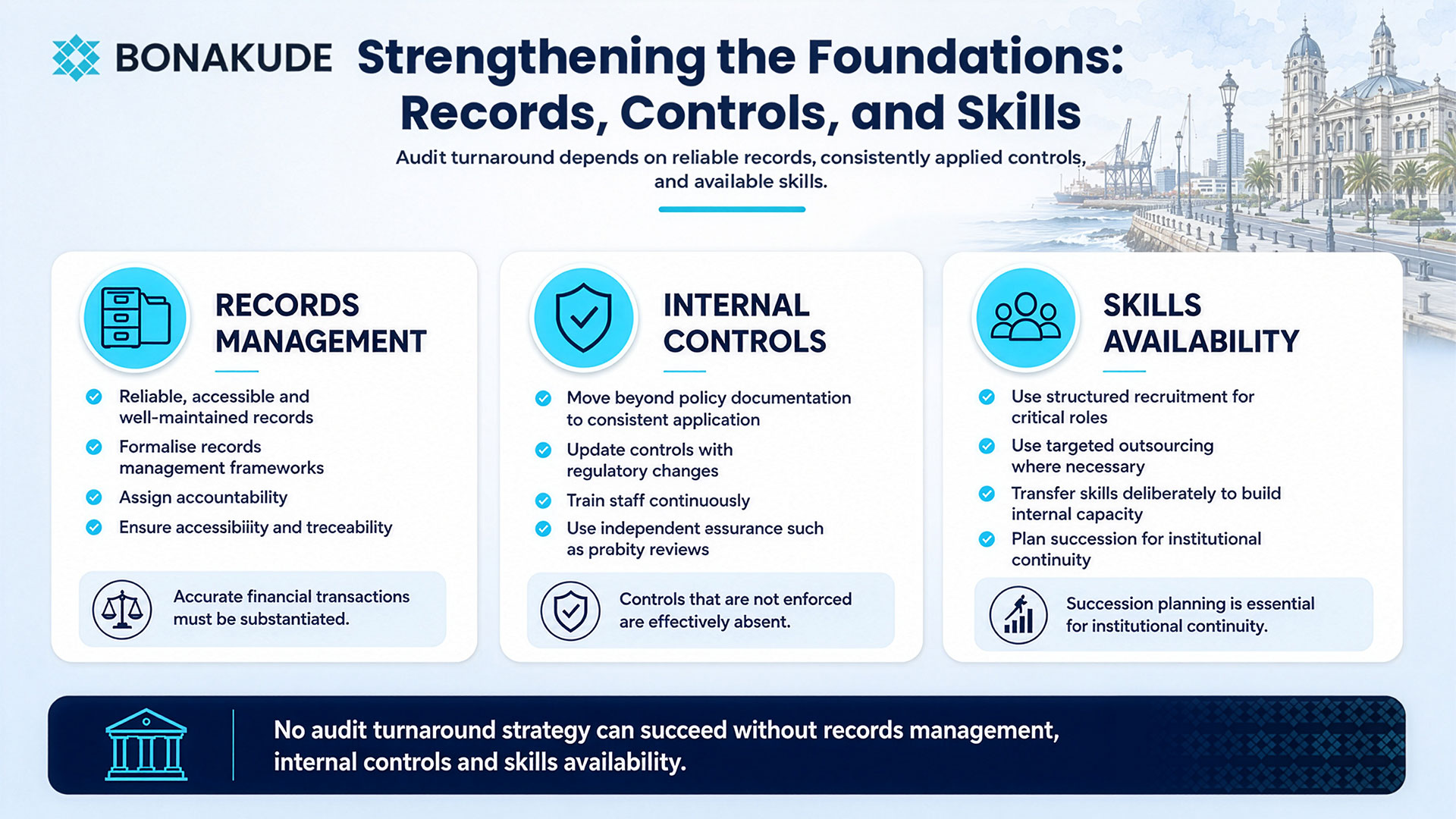
No audit turnaround strategy can succeed without addressing three foundational pillars: records management, internal controls, and skills availability.
Records management is often underestimated, yet it is central to audit readiness. Without reliable, accessible, and well-maintained records, even accurate financial transactions cannot be substantiated. Institutions must therefore formalise records management frameworks, assign accountability, and implement systems that ensure both accessibility and traceability.
Internal controls must also move beyond policy documentation into consistent application. This requires regular updates aligned with regulatory changes, continuous staff training, and independent assurance mechanisms such as probity reviews. Controls that are not enforced are effectively absent.
Skills shortages remain one of the most significant structural constraints. Addressing this requires a multi-pronged approach: structured recruitment processes for critical roles, targeted outsourcing where necessary, and deliberate skills transfer programmes to build internal capacity. Succession planning should not be optional - it is essential for institutional continuity.
Click the infographic to enlarge.
Managing the Audit Process More Professionally
Audit outcomes are also shaped by how institutions engage with the audit process.
Effective audit management requires structured coordination through audit steering committees that actively monitor progress and resolve issues in real time. Information requests from auditors should be centrally managed to ensure consistency, accuracy, and timeliness.
Regular engagement between management, internal audit, and external auditors helps to reduce friction and improve clarity around high-risk areas. In many cases, audit delays and findings are not due to lack of information, but poor coordination.
Importantly, institutions should not view auditors solely as evaluators, but also as technical partners who can provide guidance on complex or high-risk areas.
The Role of Oversight Structures
Oversight bodies such as audit committees, internal audit units, and project steering committees are often established, but their effectiveness varies significantly across institutions.
Where functioning effectively, these structures improve accountability, sharpen organisational focus, and enhance monitoring of performance against objectives. However, their impact depends on the quality of membership, independence, and the seriousness with which their recommendations are implemented.
Without empowered oversight, even well-designed systems lose their corrective capacity.
Conclusion: From Audit Compliance to Institutional Discipline
The persistence of poor audit outcomes under PFMA and MFMA frameworks is not primarily a regulatory failure. It is an institutional capability challenge.
Improving audit outcomes requires a shift in mindset - from treating audits as annual compliance events to viewing them as reflections of everyday operational discipline. It requires stronger leadership, better systems, disciplined execution, and consistent accountability.
Ultimately, audit turnaround is not about satisfying auditors. It is about building public sector institutions that can manage public resources efficiently, transparently, and sustainably. When that foundation is strong, clean audits become a by-product - not the objective. Institutions that have achieved clean audit outcomes all say they just managed the basics well.
Author Bio
Prosper Mutambirwa AGA (SA) has more than 15 years Auditing and Consulting experience in the Public and Private Sectors. He is a Senior Manager in the Consulting Division at Bonakude.
Throughout the years, Prosper has been involved in several auditing and consulting assignments in the Public Sector, servicing Municipalities, National and Provincial Government Departments, Higher Education & Training Entities, and Public Entities. In the Private Sector, he has serviced entities in Healthcare, Mining, and Engineering industries.
Prosper currently manages a portfolio with FAR assignments, that feed into the AFS Preparation.
His key areas of expertise include: Internal Audit; External Audit; Accounting; AFS & Audit Turnaround; Management Consulting; Fixed Asset Management; and Revenue Management.
We partner with you to make your business work; with foresight, integrity and lasting solutions.
Level 1 B-BBEE | National footprint | Award-winning team
How can Bonakude support your audit turnaround and operational efficiency?Frequently Asked Questions
Why do South African public sector institutions continue to receive poor audit outcomes?
Persistent audit challenges are often linked less to regulatory complexity and more to operational weaknesses, including inadequate financial management skills, poor records management, weak internal controls, vacancies in critical positions and ineffective consequence management.
What is audit turnaround in the public sector?
Audit turnaround is the process of improving an institution’s financial management, internal controls, reporting systems and accountability so that recurring audit findings are resolved and improved audit outcomes can be sustained over time.
How can municipalities and government departments improve audit outcomes?
Improvement requires continuous financial management rather than year-end preparation, credible annual financial statement processes, effective audit action plans, stronger records management, appropriate skills, functioning internal controls and active oversight.
Why is audit readiness important for operational efficiency?
Audit readiness reflects the quality of an organisation’s everyday financial and operational discipline. Reliable records, accurate reporting, effective controls and clear accountability improve both audit outcomes and the institution’s ability to manage public resources efficiently.
Are clean audits the ultimate objective of public sector financial management?
A clean audit should be viewed as an outcome of strong institutional capability rather than the sole objective. The broader goal is to build public institutions that manage resources efficiently, transparently and sustainably while maintaining effective governance and accountability.