Municipal Revenue Credibility Begins Upstream

A municipality's annual financial statements tell the accumulated story of thousands of operational decisions. Revenue and receivables figures do not begin in the general ledger. They begin when a property is registered, a valuation is captured, a service is connected, a meter is read, a tariff is applied, an account is delivered and a payment or query is processed.
If any link in that chain is incomplete or inaccurate, the error travels. An omitted property suppresses billing. An incorrect customer category applies the wrong tariff. A missing meter reading weakens the estimate of consumption. An unresolved billing dispute can remain in debtors until collectability is overstated. Year-end journals may change the reported number, but they cannot create the underlying evidence or repair the operating process that produced it.
The scale of the challenge is visible in current public reporting. The Auditor-General of South Africa's 2024-25 local government report records material misstatements in revenue and receivables in the financial statements submitted for audit by 162 municipalities. Of these, 80 municipalities, or 49%, still had materially misstated revenue and/or outstanding debtors in their published financial statements. National Treasury reported aggregate municipal consumer debt of R484 billion at 31 March 2026, with R424.7 billion, or 87.7%, outstanding for more than 90 days. Not every rand in that balance will be recoverable. That makes accurate ageing, impairment and supporting evidence as important as billing and collection.
By Tumelo Diphokoje AGA(SA) - Project Manager at Bonakude
Revenue is an institutional value chain
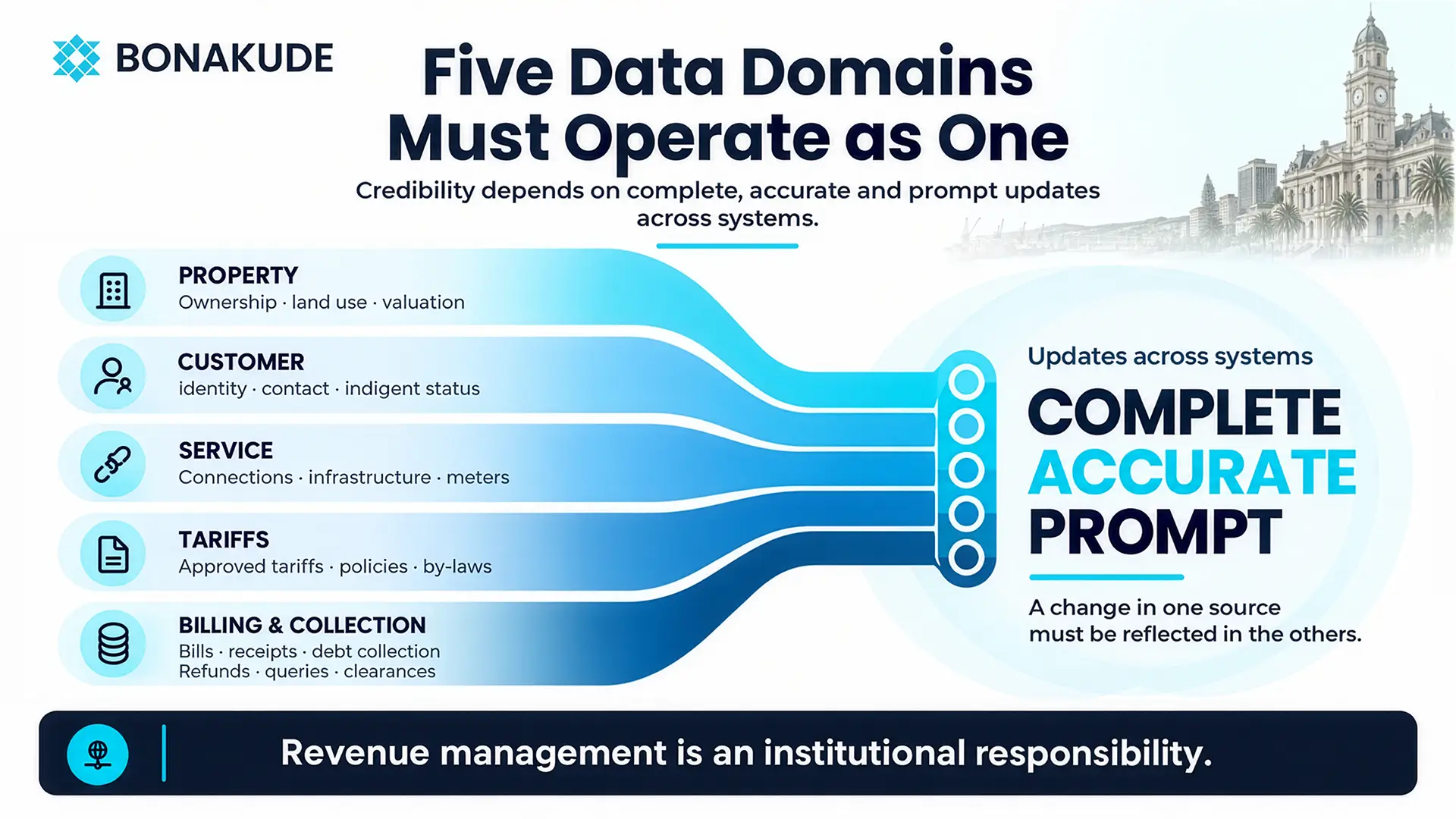
Treating revenue management as a finance-only function is a structural mistake. National Treasury's revenue-management guidance describes it as a routine municipal function and stresses the need to integrate the functions along the revenue value chain. That integration must connect at least five information domains:
- property, ownership, land-use and valuation data;
- customer identity, contact and indigent-status data;
- service connections, infrastructure and meter data;
- approved tariffs, policies and by-laws; and
- billing, receipting, debt collection, refunds, queries and clearance processes.
These domains often sit in different departments and systems. The organisational question is therefore not simply whether each dataset exists. But rather whether changes in one source are reflected completely, accurately and promptly in the others. A new development known to town planning but absent from the valuation or billing system represents lost or delayed revenue. A meter replacement recorded by technical services but not linked to the correct customer account creates a billing risk. A customer query resolved at a service centre but not reflected in the debtor record weakens both collection and reporting.
Click the infographic to enlarge.
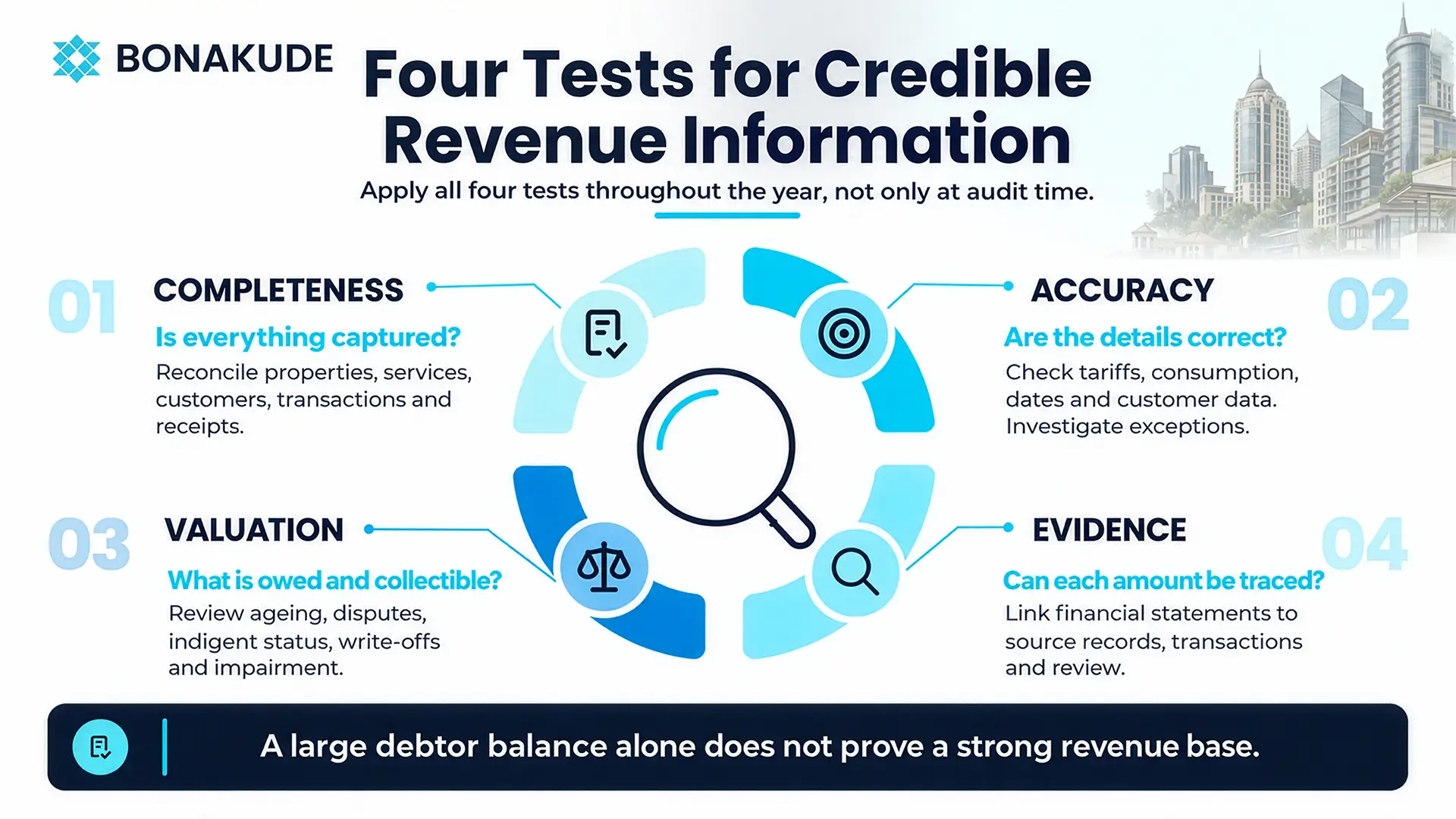
Four tests for credible revenue information
Municipal leaders can make the quality of revenue information visible by applying four tests throughout the year.
Completeness: Are all rateable properties, active service points, customers, transactions and receipts captured? Completeness should be demonstrated through reconciliations between the deeds and valuation records, town-planning approvals, service-connection records, meter registers, billing runs and the general ledger.
Accuracy: Were the correct category, tariff, consumption, dates and customer details used? Exception reports should identify unusual consumption, dormant or unbilled meters, zero-value accounts, duplicate customers, negative balances and manual adjustments for investigation before they become recurring errors.
Valuation: Does the receivable reflect the amount genuinely owed and reasonably collectible? Debt ageing, disputes, indigent status, write-offs and impairment assumptions must be supported, consistently applied and reviewed against collection experience. A large debtor balance is not, by itself, evidence of a strong revenue base.
Evidence: Can the municipality trace each material amount from the financial statements back to authorised tariffs, source records, billing transactions, receipts, reconciliations and review? Good record keeping is not an audit-season filing exercise. It is part of the control performed when the transaction occurs.
Click the infographic to enlarge.
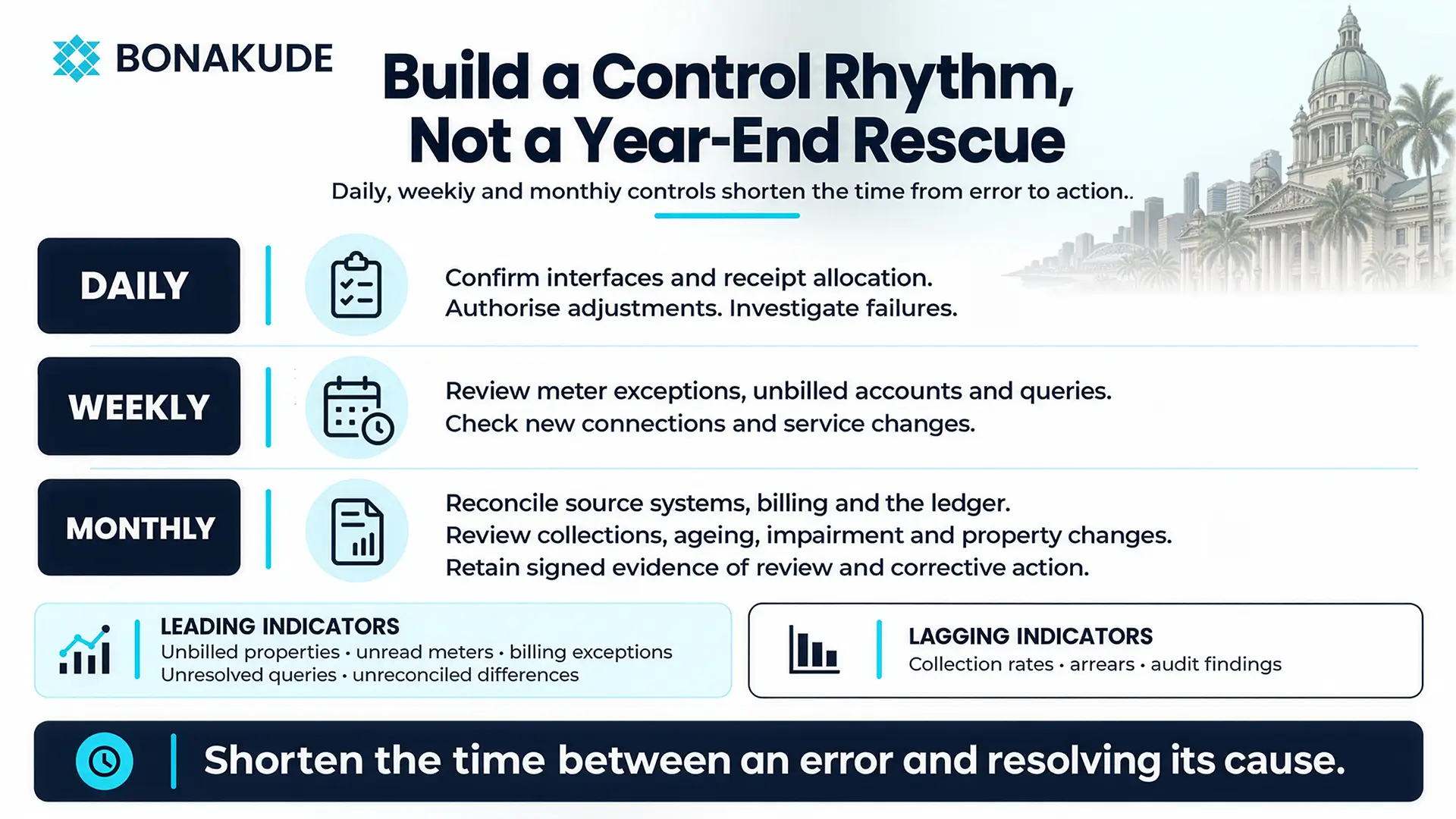
Build a control rhythm, not a year-end rescue
The Municipal Finance Management Act places responsibility for revenue management with the accounting officer and requires effective revenue-collection systems, monthly revenue calculations, reconciliations and clear accounts. The Municipal Systems Act links this responsibility to customer management, regular accurate accounts, accessible query processes and the implementation of credit-control and debt-collection policies. The practical response is a control rhythm that operates every day, week and month.
Daily controls should confirm that interfaces ran, receipts were allocated, reversals and adjustments were authorised, and failed transactions were investigated. Weekly reviews should focus on meter-reading exceptions, unbilled accounts, unresolved queries, new connections and service changes. Monthly controls should reconcile source systems to the billing system and general ledger; review collection rates and debt ageing; test impairment inputs; track valuation and deeds changes; and retain signed evidence of preparation, review and corrective action.
The aim is not to produce more reports, but rather to shorten the time between an error entering the system and management resolving its cause. A useful control dashboard should therefore show leading indicators, such as unbilled properties, unread meters, billing exceptions, unresolved queries and unreconciled differences, alongside lagging indicators such as collection rates, arrears and audit findings.
Click the infographic to enlarge.
Make collective accountability explicit
Clean administration depends on three connected layers of responsibility. Leadership must set clear policies, assign data ownership, require documented follow-up and monitor whether corrective actions close root causes. Finance, revenue, budget, technical services, valuations, town planning and customer-care teams must perform and evidence the operational controls. Internal audit, the audit committee, risk management structures, the municipal public accounts committee and council must challenge persistent exceptions and test whether reported progress is real.
A focused 90-day reset can establish this discipline. First, map the revenue value chain, its source systems, control owners and evidence. Second, reconcile the highest-risk datasets and place every material difference on a dated exception register with an accountable owner. Third, embed a monthly revenue-control pack that reports both financial outcomes and unresolved data-quality risks to management and the appropriate oversight structures.
This work supports more than an audit opinion. Accurate revenue information improves cash-flow forecasting, budget credibility, collection decisions, infrastructure planning and the municipality's ability to respond fairly to customers. It also helps leaders distinguish between revenue that has not been billed, debt that has not been collected and balances that may never be collectible.
A clean audit is not created by year-end preparation. It is rather the outcome of reliable data, disciplined processing, effective governance and continuous oversight across the institution. Municipalities strengthen both financial reporting and service delivery when they manage revenue as an integrated operating system rather than a number to be repaired after the year has closed.
Author Bio
Tumelo Diphokoje has more than 14 years Auditing and Consulting experience in the Public and Private Sectors.
He is a Project Manager at Bonakude, responsible for managing a portfolio of municipal clients wherein sound advisory and support are provided in the preparation of GRAP Complaint Annual Financial Statements, GRAP Compliant Fixed Assets Registers, Revenue Management Reporting and in Auditing.
As a former Chief Financial Officer (CFO) of a Local Municipality he possess proven experience in stabilising municipal finance functions, improving audit outcomes, strengthening budget credibility, and leading the preparation of Annual Financial Statements (AFS) in compliance with MFMA, GRAP and National Treasury requirements.
Among his many career highlights, he successfully oversaw the first-time internal preparation of AFS in a municipality. Moreover, he has assisted numerous municipalities with developing and implementing Revenue Enhancement Plans.
His key areas of expertise include: External Audit; Accounting; AFS Preparation & Audit Turnaround; Management Consulting; Fixed Asset Management; and Revenue Management.
Professional Affiliations
- Member of South African Institute of Chartered Accountants (SAICA)
- Member of Institute of Internal Auditors South Africa (IIA SA)
We partner with you to make your business work; with foresight, integrity and lasting solutions.
Level 1 B-BBEE | National footprint | Award-winning team
How can Bonakude support stronger municipal revenue management?Frequently Asked Questions
Why can revenue and receivables not simply be corrected at year-end?
Because the reported balances are produced by source data and transactions accumulated throughout the year. A journal can amend a number, but it cannot reliably reconstruct missing property records, meter readings, customer interactions, authorisations or other audit evidence.
Which datasets should municipalities reconcile first?
Start with the highest-risk links between deeds and valuation records, property and customer accounts, service connections and meters, approved tariffs and billing, cash receipts and customer balances, and the billing system and general ledger.
What should oversight structures monitor each month?
They should monitor billing completeness, exception volumes, reconciliation differences, collection performance, debt ageing, disputes, impairments and the age and status of corrective actions. The dashboard should identify accountable owners and retain evidence that issues were reviewed and resolved.